
OpenClaw Is Trending — But AI Agents in Semiconductor Fabs Have Been Running for Years
Key Takeaway
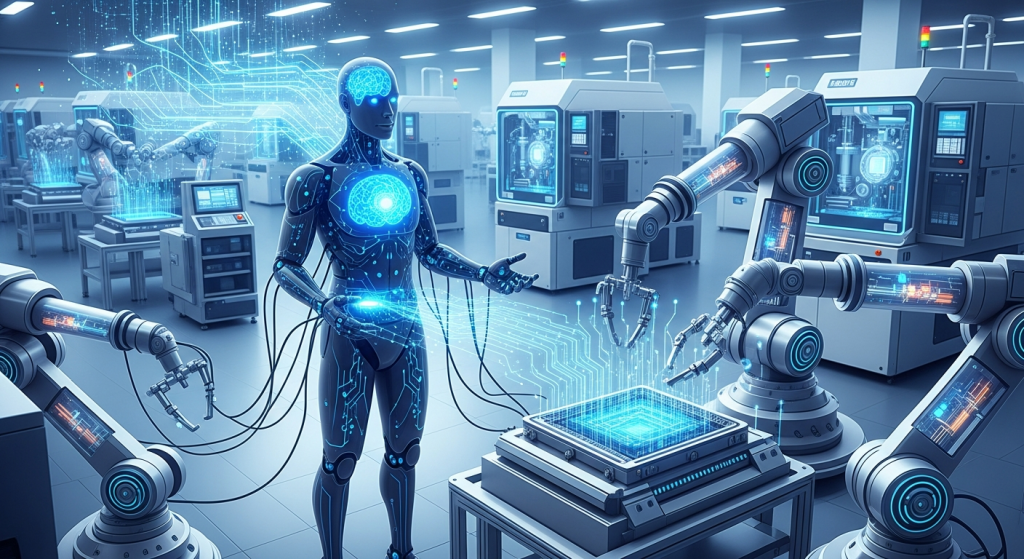
Industrial AI Agents for semiconductor fabs require sub-50ms latency, zero tolerance for errors, and continuous operation. Unlike consumer AI agents like OpenClaw, NeuroBox E3200 functions as a semiconductor equipment AI Agent: sensing, predicting, and auto-adjusting in real-time.
OpenClaw just exploded — an open-source AI agent framework with 260K GitHub stars, called “the most important software release of our time” by Jensen Huang. It lets users build always-on AI assistants that schedule meetings, write code, manage files, and connect to messaging platforms.
But here is the thing: in semiconductor fabs, AI agents are not new. They have been controlling equipment, predicting wafer quality, and auto-tuning recipes in real time.
OpenClaw vs. Semiconductor AI Agents
| OpenClaw | Semiconductor AI Agent | |
|---|---|---|
| Use case | Office automation, info management | Real-time equipment control, process optimization |
| Latency requirement | Seconds — retry on failure is fine | Milliseconds — failure means scrapped wafers |
| Data environment | Internet-scale, abundant | Factory data, scarce and highly sensitive |
| Deployment | Cloud or local | Edge-only, data never leaves the fab |
| Error tolerance | High (just retry) | Near zero (each wafer costs $100+) |
OpenClaw’s core value is upgrading AI from “chatting” to “executing.” But on semiconductor production lines, AI agents have been “executing” from day one — not writing emails, but adjusting process parameters wafer-by-wafer, predicting quality in real time, and detecting equipment anomalies at millisecond speed.
Three AI Agent Scenarios Already Running in Fabs
1. Virtual Metrology Agent (VM)
Traditional approach: After processing, wafers queue for physical metrology. Only 5-10% get measured — the rest are blind spots.
AI Agent approach: The instant a wafer exits the chamber, the agent predicts quality metrics from equipment sensor data. No physical measurement needed. 100% coverage. Anomalies caught in seconds.
Result: 70% reduction in physical metrology frequency. Anomaly miss rate dropped from 18% to 3%.
2. Run-to-Run Control Agent (R2R)
Traditional approach: Engineers watch SPC charts, manually adjust recipes when drift is spotted. Slow. Experience-dependent.
AI Agent approach: After every wafer, the agent calculates compensation and updates the next wafer’s recipe automatically. Equipment drift is tracked and corrected in real time.
Result: Cpk improved from 1.1 to 1.5+. Significantly better process stability.
3. Equipment Health Agent (FDC/PHM)
Traditional approach: Fix equipment when it breaks, or run PM on fixed schedules regardless of actual condition.
AI Agent approach: Continuously monitors sensor data, predicts failure trends, and alerts before problems occur.
Result: 40% reduction in unplanned downtime. 20% optimization of PM cycles.
Why Semiconductor AI Agents Are Harder Than OpenClaw
Challenge 1: Small data.
OpenClaw runs on large language models trained on trillions of tokens. Semiconductor equipment AI faces: zero data on new tools, process changes that invalidate historical data, and strict data-residency requirements.
Solution: Physics-informed + small-sample learning. Physical equations (Preston equation, Stribeck curve) provide 90% of prior knowledge. AI only needs to learn the remaining 10% of tool-specific variation. 10-15 wafers is enough to build a model.
Challenge 2: Real-time requirements.
OpenClaw can take a few seconds per task. VM prediction must complete the instant a wafer exits the chamber. R2R adjustments must be ready before the next wafer enters.
Solution: Edge deployment. Models compressed to 82KB, inference latency under 100ms, deployed right next to the equipment — no cloud round-trip.
Challenge 3: Zero tolerance for error.
OpenClaw sends a wrong email? Resend it. An AI agent mispredicts wafer quality? That is hundreds of dollars lost and downstream cascading effects.
Solution: Uncertainty quantification. Every prediction includes a confidence interval. When the model is uncertain, it triggers physical measurement automatically — no missed defects.
What OpenClaw’s Success Tells Us
OpenClaw’s viral adoption proves one thing: the shift from conversational AI to agentic AI is irreversible.
In office environments, this shift is just beginning. In semiconductor manufacturing, it has already happened — just without the GitHub stars and media hype.
Because industrial AI agents do not need viral attention. They need to run quietly, reliably, 24/7, and never get a single wafer wrong.
That is the most hardcore form of AI agent there is.
Learn more about semiconductor AI agents in production:
- NeuroBox E3200 — Inline AI Agent for VM / R2R / FDC
- NeuroBox E5200 — Equipment Commissioning AI Agent (Smart DOE)
- SECS/GEM Online Reference Tool — Free equipment communication protocol lookup
这篇属于 NeuroBox D 设计自动化场景
获取一份 NeuroBox D 设计自动化评估,看看 P&ID 到 SolidWorks 原生装配体如何接入您的工程流程。
把 P&ID 图纸类型、客户零件库现状、3D 空间边界和装配规则发给我们。工程团队会先判断适合从哪一个机械设计环节切入,再给出落地建议。
- 适合设备商、气路/机械设计、CAD 自动化和工程复核团队
- 可从 P&ID、SolidWorks 零件库、装配规则和空间边界开始
- 优先评估旁接式本地 D 盒子,不要求上传机密图纸到公有云
Discover how MST deploys AI across semiconductor design, manufacturing, and beyond.