Edge AI vs Cloud AI: Choosing the Right Architecture for Semiconductor Fabs
Key Takeaway
Edge AI delivers sub-50ms latency vs 500ms+ for cloud, with data staying on-premises. For semiconductor manufacturing, edge deployment is essential for real-time control. NeuroBox uses NVIDIA Jetson Orin for on-equipment AI inference.
A Question We Are Asked Repeatedly
In discussions with wafer fabs and equipment manufacturers, we are frequently asked: “Should our AI solution be deployed in the cloud or at the equipment edge?”
This seemingly simple question actually determines whether a semiconductor AI project can be successfully deployed. Choosing the wrong architecture can at best delay the project; at worst, it creates data security vulnerabilities.
Advantages and Limitations of Cloud AI
The advantages of cloud AI are well established: abundant compute resources, the ability to run very large models, and centralized data management that simplifies training. For offline analysis, process R&D, and other non-real-time scenarios, cloud AI is the appropriate choice.
However, in the semiconductor production line environment, cloud AI faces several hard constraints:
- Latency: Equipment control requires millisecond-level response times; the round-trip latency of uploading data to the cloud and receiving results back is unacceptable
- Data security: A fab’s process data is proprietary and confidential; most fabs explicitly mandate that data must not leave the facility
- Network dependency: Network conditions in production environments are complex; an AI system that “goes dark” when the network drops is a non-starter
- Deployment costs: Ongoing cloud platform subscriptions, dedicated network line upgrades, and additional operations staff
Why Edge AI Is Better Suited for Semiconductor Production Lines
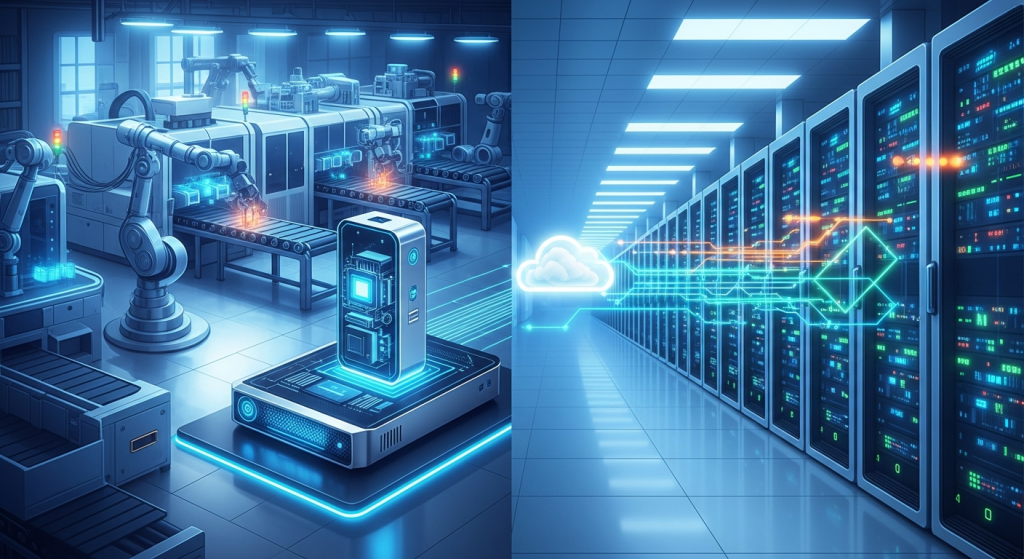
Edge AI deploys inference capabilities on edge nodes close to the equipment, collecting data from the equipment directly, running models locally, and outputting decisions on-site. This architecture inherently resolves the issues described above:
| Dimension | Cloud AI | Edge AI |
|---|---|---|
| Response latency | 100ms to 1s+ | <10ms |
| Data security | Data uploaded to cloud; requires encrypted transmission | Data never leaves the equipment; local closed loop |
| Network dependency | Strong dependency | Capable of offline operation |
| Deployment approach | Requires IT infrastructure modifications | Plug-and-play; no changes to production line architecture |
| Suitable scenarios | Offline analysis, model training | Real-time control, online prediction, equipment diagnostics |
Particularly in the three core use cases of Virtual Metrology (VM), R2R automatic tuning, and equipment fault prediction, edge AI’s real-time performance advantage is virtually irreplaceable.
Best Practice: A Hybrid Edge + Cloud Architecture
Of course, edge and cloud are not mutually exclusive. The industry best practice is a “edge inference + cloud training” hybrid architecture:
- Edge: Deploy lightweight inference models for real-time data acquisition, online prediction, and immediate decision-making
- Cloud / on-premises server: Aggregate de-identified feature data for large-scale model training and iterative optimization
- Model updates: Newly trained models are periodically pushed to edge nodes, continuously improving prediction accuracy
This architecture ensures production line real-time performance and security while fully leveraging cloud compute power for model iteration.
How to Evaluate an Edge AI Solution
If you are evaluating AI solutions for your semiconductor production line, we recommend focusing on the following key dimensions:
- Equipment protocol support: Does it natively support SECS/GEM, and can it connect directly to equipment without additional gateways?
- Compute specifications: Does the edge node’s GPU/NPU compute power meet real-time inference requirements?
- Deployment intrusiveness: Does it require modifications to existing MES/EAP systems, or can it be deployed as a “sidecar” alongside existing infrastructure?
- Small-sample adaptability: Can the model cold-start quickly when facing new processes or new equipment?
- Security compliance: Does data processing meet the facility’s security requirements?
MST Semiconductor’s NeuroBox Edge AI Platform is designed around these requirements. Built on the NVIDIA Jetson Orin NX edge computing chip with native SECS/GEM protocol support, it offers plug-and-play deployment to help wafer fabs and equipment manufacturers achieve rapid AI adoption.
读完这篇,下一步可以很具体
获取一份产线 AI 评估,看看 NeuroBox E3200 / SECS/GEM 怎么接到您的设备。
把设备类型、当前数据接口、工艺目标或良率问题发给我们。工程团队会先判断适合 VM、R2R、Smart DOE、EIP 还是能源优化,再给出下一步建议。
- 适合晶圆厂、设备商、工艺/设备/自动化团队
- 可从 SECS/GEM、Modbus、PLC、CSV/历史数据开始
- 不需要先提交机密 recipe 或客户图纸
Discover how MST deploys AI across semiconductor design, manufacturing, and beyond.