
Digital After-Sales Service: AI-Powered Equipment Support
Key Takeaway
Digital after-sales transforms semiconductor equipment support from reactive field service to AI-driven remote diagnostics — reducing on-site engineer visits by 60% and mean time to resolution (MTTR) from days to hours. Equipment makers using NeuroBox can monitor customer tools remotely, detect issues before customer calls, and resolve 70% of faults without dispatching an engineer.
The Hidden Cost Crisis in Semiconductor Equipment After-Sales
Ask any equipment sales director what keeps them up at night, and the answer rarely involves the initial sale. It involves everything that happens afterward. Semiconductor equipment after-sales service is a sprawling, expensive, labor-intensive operation that consumes margins, strains relationships, and scales poorly as installed base grows. A single unplanned field service visit to a customer fab — factoring in flight, hotel, engineer labor, parts logistics, and opportunity cost — typically runs between $3,000 and $8,000. Multiply that by a few hundred visits per year across a global installed base, and the arithmetic becomes uncomfortable fast.
The traditional model has not fundamentally changed in thirty years. A customer tool alarms or underperforms. The customer calls the equipment hotline. A support engineer attempts remote diagnosis via phone or video call, working from a limited data feed and whatever the customer operator can describe. If the issue cannot be resolved remotely — and most cannot, under the traditional model — a field engineer is dispatched. They arrive one to three days later, diagnose on-site, order parts, wait, and return. Mean time to resolution stretches to five to ten business days. The customer’s tool sits idle or runs at degraded yield throughout.
This model is not just expensive. It is structurally misaligned with how modern fabs operate. Fabs run 24/7. Yield excursions cost tens of thousands of dollars per hour. The idea that critical equipment should wait for a human to fly across the Pacific before diagnosis begins is no longer acceptable to customers who understand what digital infrastructure can do.
What a Field Service Visit Actually Costs
Breaking down the true cost of a field service visit reveals why equipment makers are so eager to reduce visit frequency even marginally. The direct costs are the visible part: engineer travel (average $1,200–2,500 for international), accommodation ($150–300 per night, often multiple nights), engineer day rate ($800–1,500), and parts expediting fees when components need to be shipped urgently ($200–800). That gets you to $3,000–$5,000 before anything goes wrong.
The indirect costs are larger. Every hour a field engineer spends traveling is an hour not available for other customers. Support organizations with tight headcount run into queuing problems — a field engineer tied up in a three-day on-site engagement cannot be simultaneously dispatched for two other urgent calls that arrive that week. Customer satisfaction scores erode during wait periods. Contracts that guarantee certain response SLAs require expensive geographic staffing buffers to meet.
Then there is the customer’s cost, which sophisticated buyers increasingly factor into total cost of ownership discussions. An idle CVD chamber or etch tool costs a leading-edge fab $15,000–40,000 per hour in lost wafer output. Even a tier-two MEMS fab might lose $3,000–8,000 per idle tool-hour. Five days of downtime while waiting for a field engineer is a number that gets raised in equipment selection discussions for the next purchase cycle.
The business case for digital equipment support AI is not primarily about cost reduction for the equipment maker — though that matters. It is about fundamentally improving the customer’s experience with unplanned downtime, which is the single most important driver of repeat purchase decisions and installed base expansion.
Remote Diagnostics Architecture: How It Works
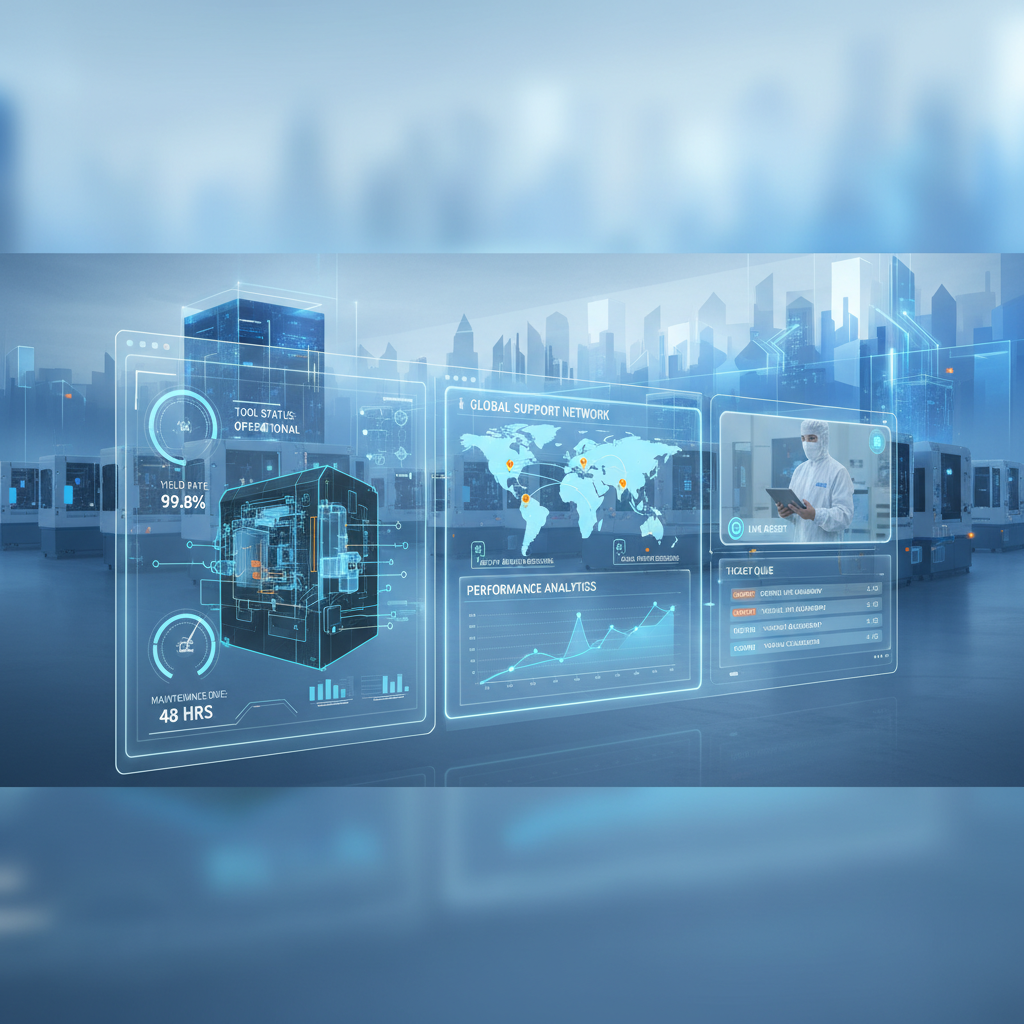
A modern remote diagnostics architecture for semiconductor equipment operates across three layers, each serving a distinct function in the service delivery chain.
The edge layer lives inside the customer fab, co-located with the equipment. This layer collects raw sensor data — temperatures, pressures, flow rates, RF power readings, endpoint signals, motor current traces, vibration signatures — at high frequency, typically between 100 Hz and 10 kHz depending on the signal type. Edge processing performs initial filtering and feature extraction, reducing a raw data stream of several gigabytes per hour to a structured feature set of a few megabytes. This compression is essential for two reasons: it limits network bandwidth requirements, and it ensures that only processed features — not raw process data — leave the customer’s facility.
The transport layer manages secure, authenticated data transmission from the fab to the equipment maker’s cloud infrastructure. Modern implementations use mutual TLS with certificate pinning, encrypted at rest and in transit, transmitted over dedicated VPN tunnels or HTTPS endpoints with customer-controlled firewall rules. The customer retains the ability to inspect, audit, and terminate data transmission at any time. Critically, the data that travels is engineering telemetry — equipment health signals — not wafer process results or recipe parameters.
The cloud analytics layer is where AI-driven diagnosis occurs. This layer runs continuously trained fault detection models, anomaly scoring algorithms, and root cause classifiers. When an anomaly is detected, the system generates a structured diagnostic report: which subsystem is implicated, what the probable root cause is, what corrective action is recommended, and what the confidence level of the diagnosis is. This report routes to both the equipment maker’s service team and, optionally, the customer’s maintenance staff through a shared service portal.
Data Security: What Can Be Shared and What Cannot
Data security is the first objection raised in every digital equipment support conversation with fab customers, and it is a legitimate one. Semiconductor fabs guard their process data and recipes as core intellectual property. The fear is that connecting equipment to a vendor’s cloud means exposing yield-critical process knowledge to a supplier who also serves competitors.
The answer lies in a careful distinction between equipment health telemetry and process information. Equipment health telemetry — pump speeds, heater temperatures, valve positions, RF matching network states, chiller inlet and outlet temperatures, particle counts in exhaust streams — tells an equipment engineer about the mechanical and electrical health of the tool. It does not reveal what material is being deposited, at what thickness, with what dopant concentration, or for what customer product. A flow controller drifting 2% from its setpoint is diagnosable from the telemetry stream without any knowledge of what process is running.
Well-designed remote diagnostics systems are architected around this distinction. The edge agent is configured to capture and transmit equipment health channels only. Process recipe parameters, wafer ID tracking, lot genealogy, and yield data remain entirely within the fab’s network and are never transmitted. Customers can audit the data collection configuration, review exactly which channels are being sent, and modify the configuration at any time.
Beyond architecture, contractual data governance matters. Equipment makers operating digital service platforms should have clear data processing agreements specifying that telemetry data will not be shared with third parties, will not be used to derive process knowledge, and will be deleted within a defined retention window. These agreements, combined with transparent technical architecture, address the legitimate concerns that prevent fab customers from adopting remote diagnostics.
AI Fault Prediction: From Reactive to Proactive Service
The most transformative capability enabled by continuous telemetry is not faster diagnosis of existing faults. It is prediction of faults before they manifest as downtime. This shift — from reactive field service to proactive outreach — fundamentally changes the customer relationship dynamic.
Fault prediction in semiconductor equipment typically relies on multivariate time-series anomaly detection. Equipment operates within normal operating envelopes for each of its sensors. These envelopes are not static — they shift with recipe, ambient conditions, and cumulative tool age. A sophisticated prediction model learns the expected multivariate operating envelope for a given tool state and flags deviations that, historically, have preceded specific failure modes.
For example: a dry pump in a CVD system begins showing a subtle increase in motor current draw approximately 72–120 hours before a mechanical failure that would halt the tool. The increase is too small to trigger any hardcoded threshold alarm — perhaps 3–5% above historical normal — but it is statistically distinguishable from normal variation when examined in the context of 500 other pump traces from similar tools. A trained model identifies this pattern and generates a warning: “Pump P3 showing early wear signature. Recommend inspection within 72 hours.”
The equipment maker’s service team receives this alert and proactively contacts the customer. Instead of a panicked call at 2 AM when the tool has stopped, the conversation is: “Our remote monitoring system flagged a potential issue with your pump — can we schedule a PM visit for Thursday?” The customer experiences this as exceptional service. The equipment maker has avoided an unplanned emergency dispatch and replaced it with a scheduled, efficient visit. Both parties win.
Digital Service Contract Models
Digital service capabilities enable new commercial models that were not viable under traditional field-service economics. Two primary models have emerged in the semiconductor equipment industry: subscription-based digital service contracts and per-incident digital support.
The subscription model charges customers a fixed annual or monthly fee for continuous remote monitoring, proactive alerts, and a guaranteed remote-first response to any issue. The fee is tiered by tool count and criticality. A typical entry-level remote monitoring subscription for a single tool might run $15,000–25,000 per year — substantially less than two or three emergency field service visits. At the high end, comprehensive digital service agreements for a fleet of critical tools might run $80,000–150,000 per year but include response time guarantees, dedicated remote support engineers, and predictive maintenance scheduling.
The per-incident model charges for each remote support engagement rather than providing continuous coverage. This model suits customers with lower-volume fleets who want access to digital diagnostics without a recurring commitment. A remote diagnostic engagement might be priced at $500–1,500, versus $3,000–8,000 for a field visit — the value proposition is clear even without a subscription.
Both models create revenue streams that did not exist before. Equipment makers who previously monetized after-sales service primarily through spare parts sales and time-and-materials field visits now have a software-defined service layer that generates recurring revenue with very low marginal cost per additional customer tool.
Customer Self-Service Portal
Digital equipment support is not exclusively about what the equipment maker does with data — it is also about what the customer can do for themselves. A well-designed customer self-service portal gives maintenance engineers and process engineers direct visibility into equipment health without requiring a call to the equipment maker.
A modern self-service portal surfaces real-time and historical trend data for all monitored channels, interpreted through equipment-maker-trained models. Rather than showing a raw sensor trace that requires expert interpretation, the portal shows a simplified health score for each subsystem — “RF system: Healthy,” “Process gas delivery: Monitor,” “Pump train: Warning” — with drill-down capability for engineers who want to see the underlying data.
Fault history, corrective actions taken, and maintenance records are accessible through the same portal. Customers can open service tickets, track ticket status, and access repair documentation. For recurring issues, the portal surfaces the solution from previous similar incidents automatically — closing a significant fraction of issues through self-service before any support engineer is involved.
Self-service portals reduce inbound support call volume by 30–40% in deployments that have measured it. They also improve customer satisfaction scores because customers feel more in control and less dependent on opaque support processes. The equipment maker benefits from reduced support load and richer data on which issues customers are encountering and resolving on their own.
SLA Transformation: The Metrics That Change
Switching to digital-first equipment support changes the SLA metrics that matter and what is achievable against them. Under the traditional model, the primary SLA metric is time-to-dispatch: how quickly after a customer call does a field engineer reach the site. Typical contractual commitments range from 24 to 72 hours. Best-in-class organizations achieve 24-hour dispatch to major markets but cannot economically guarantee this globally.
Under a digital service model, dispatch time becomes secondary because most issues are resolved without dispatch. The primary SLA metrics shift to time-to-first-contact (measured in minutes, not hours), time-to-diagnosis (typically 1–4 hours with remote telemetry access), and resolution rate without field visit (target: 70% or higher). For the subset of issues that do require a field visit, the diagnostic work is already done remotely before the engineer boards a plane — meaning the engineer arrives with the right parts, the right procedure, and a clear understanding of what needs to be done. On-site time drops from 2–3 days to 4–8 hours.
Mean time to resolution (MTTR) across all issue types typically drops from 5–8 business days to under 24 hours with digital-first support. This metric — which directly translates to customer uptime — is the headline number that drives customer purchase and renewal decisions.
NeuroBox Remote Service Module
MST’s NeuroBox platform includes a purpose-built remote service module designed for semiconductor equipment makers who want to deploy digital after-sales capabilities without building the analytics infrastructure from scratch. The module integrates with existing equipment control systems through standard interfaces (OPC-UA, SECS/GEM, or direct API) and begins collecting equipment health telemetry with minimal installation effort.
The remote service module includes pre-built fault detection models trained on MST’s cross-customer equipment fleet. Rather than starting from zero with a new customer’s tool data, the models begin with fleet-level priors accumulated across thousands of tool-months of operational data — which means useful anomaly detection capability from the first day of deployment, not after six months of model training.
The customer-facing portal is white-labeled and configurable, allowing equipment makers to deploy it as their own branded service portal. The alert workflow integrates with common service management systems (ServiceNow, Salesforce Service Cloud) so that remote diagnostics fit into existing service operations without requiring process redesign.
ROI for Equipment Makers Switching to Digital Service
The return on investment calculation for digital equipment support is straightforward but often underestimated because it involves multiple value streams that are rarely tracked in the same place.
On the cost reduction side: if an equipment maker executes 400 field service visits per year at an average fully-loaded cost of $5,500, that is $2.2 million in annual field service expense. Reducing visit frequency by 60% through digital diagnostics saves $1.32 million annually — enough to fund a substantial software and operations investment with meaningful margin remaining.
On the revenue side: digital service contracts at $20,000 average annual contract value, sold to 30% of an installed base of 500 tools, generate $3 million in new recurring revenue. This revenue has very low marginal cost — the core infrastructure is built, and each additional tool requires only incremental compute and support capacity.
On the customer retention side: the impact is harder to quantify but arguably the largest. Equipment makers who have deployed remote monitoring programs report renewal rates 15–25 percentage points higher among enrolled customers compared to non-enrolled customers. When the next equipment purchase cycle arrives, a customer whose uptime has been visibly protected by the equipment maker’s digital service team is dramatically more likely to remain with the same vendor.
The total ROI for a mid-sized equipment maker transitioning to digital-first after-sales support, including cost savings, new service revenue, and retention uplift on a $50M installed base revenue stream, typically exceeds 400% over a three-year horizon. The investment required — primarily in platform development, integration, and service team retraining — is recovered in under eighteen months in most deployments MST has modeled.
Digital after-sales service is not a future capability — it is a current competitive requirement. Equipment makers who have not yet built remote diagnostics capability are losing service revenue, bearing unnecessary field service costs, and delivering worse customer uptime than the leaders in the category. The transition is achievable, the economics are compelling, and the technology to support it exists today.
读完这篇,下一步可以很具体
获取一份产线 AI 评估,看看 NeuroBox E3200 / SECS/GEM 怎么接到您的设备。
把设备类型、当前数据接口、工艺目标或良率问题发给我们。工程团队会先判断适合 VM、R2R、Smart DOE、EIP 还是能源优化,再给出下一步建议。
- 适合晶圆厂、设备商、工艺/设备/自动化团队
- 可从 SECS/GEM、Modbus、PLC、CSV/历史数据开始
- 不需要先提交机密 recipe 或客户图纸
Discover how MST deploys AI across semiconductor design, manufacturing, and beyond.