Remote Equipment Diagnostics: How Equipment Manufacturers Can Support Customers Remotely
A multi-million-dollar semiconductor tool at a customer’s production line suddenly triggers an alarm and shuts down. The customer calls the equipment manufacturer’s technical support hotline and receives this response: “Our engineer will depart the day after tomorrow and arrive on-site the day after that.” — That 48-hour wait could mean hundreds of thousands or even millions of yuan in lost capacity.
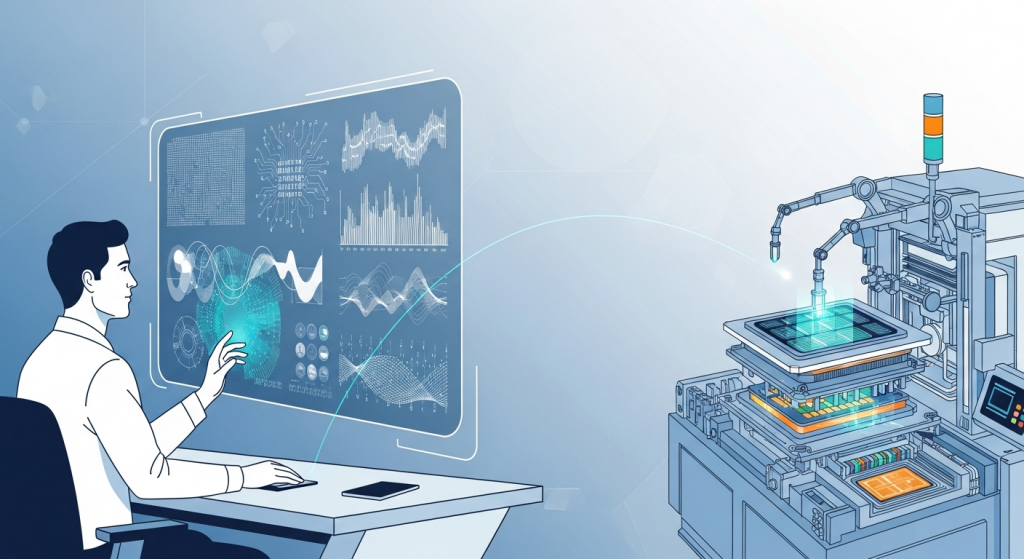
This is not an extreme case. It is a daily reality in semiconductor equipment after-sales service. The maturation of remote diagnostics technology is fundamentally changing this landscape.
The Field Service Predicament: High Cost, Slow Response, Low Efficiency
The traditional after-sales model for semiconductor equipment manufacturers is centered on field service, which faces three mounting pressures:
Rising labor costs. A single cross-regional trip by a senior equipment engineer — including airfare, accommodation, and per diem — costs 15,000 to 30,000 yuan. For overseas customers, this figure can double or triple. More critically, the engineer cannot serve other customers during the trip.
Response time cannot be compressed. Even with service centers distributed nationwide, 24-72 hours from receiving a service request to the engineer arriving on-site is standard. For remote or overseas customers, the cycle can be even longer. Meanwhile, semiconductor production line downtime losses are measured by the hour.
Low efficiency of “blind diagnosis.” After arriving on-site, engineers often spend considerable time understanding the fault context, reviewing historical data, and reproducing the issue. With insufficient information, “blind diagnosis” typically achieves only a 50%-70% First Time Fix Rate, meaning a second or even third visit may be needed.
These pain points are becoming increasingly acute as semiconductor equipment shipment volumes grow and customer distributions become more global.
Technical Prerequisites for Remote Diagnostics
Truly effective remote diagnostics is not simply “looking at the equipment screen remotely.” It requires a complete technical infrastructure:
Reliable Equipment Data Collection
The foundation of remote diagnostics is the ability to access real-time and historical equipment operating data. This includes:
- Process parameter time series data (sampling frequency of at least 1 Hz, with critical parameters at 10 Hz or higher)
- Equipment state logs (complete timeline of running, standby, maintenance, and alarm states)
- Alarm and event records (including context parameter snapshots at the time of alarm triggering)
- Cumulative operating data for key components (such as RF Hours, Pump Hours, etc.)
Data collection is not a matter of “having something is good enough.” Sufficient precision and coverage are essential. Many equipment SECS interfaces only provide low-frequency summary data, which is insufficient for diagnosing complex failures. We recommend adding an edge collection layer at the equipment level to obtain high-frequency data directly from the PLC or sensor layer.
Secure Data Transmission Channels
The sensitivity of semiconductor manufacturing data demands that data transmission meet stringent security requirements:
- End-to-end encryption: All data transmissions use TLS 1.3 or higher
- VPN or dedicated lines: Encrypted tunnels over public networks ensure transmission path security
- Data anonymization: Sensitive process parameters can be selectively masked, transmitting only diagnosis-relevant data
- Access control: Fine-grained permission management ensures equipment manufacturers can only access data within their authorized scope
Unified Remote Diagnostics Platform
Scattered tools (remote desktops, emailing files, phone calls) are inefficient and prone to information loss. Remote diagnostics requires a unified platform that can:
- Display equipment status and key parameter trends in real time
- Replay equipment operating data for any time period
- Provide collaboration tools (annotations, screenshots, work order linking)
- Accumulate diagnostic cases to build a knowledge base
How AI Takes Remote Diagnostics from “Functional” to “Exceptional”
With data collection and transmission infrastructure in place, AI elevates remote diagnostics to an entirely new level:
Real-Time Equipment State Awareness
AI models continuously analyze multi-dimensional equipment operating data, generating a real-time “digital health report” for each tool. Engineers can gain a clear picture of the equipment’s overall condition and the health of each subsystem without being on-site. When a subsystem shows degradation trends, AI issues early warnings before the customer even notices the problem, transforming “reactive response” into “proactive service.”
Automated Alarm Context Reconstruction
When equipment triggers an alarm or shuts down, AI automatically performs the following:
- Extracts a full-parameter data snapshot covering 30 minutes to 1 hour before the alarm
- Annotates the trajectory and timing of anomalous parameter changes
- Correlates concurrent equipment state changes and operator actions
- Generates a structured “fault context report”
Engineers receive not a simple alarm text message, but a complete fault analysis package. This means the starting point for remote diagnostics is no longer “What happened with the equipment?” but rather “I can see that the cooling system experienced flow fluctuations 15 minutes before the alarm, while the chamber temperature began rising. Please verify the cooling water valve status.”
Root Cause Recommendation with Confidence Scoring
Based on its learning from historical fault cases, AI provides a list of possible root causes for the current fault, along with confidence scores:
- Root Cause A: Cooling water valve blockage (85% confidence) — 72% of similar patterns in historical cases were caused by this
- Root Cause B: Cooling water pump performance degradation (45% confidence) — pump operating hours have reached the recommended maintenance interval
- Root Cause C: Abnormal ambient temperature (15% confidence) — no environmental data anomalies recorded recently
This capability is especially valuable for less experienced engineers — AI structures and quantifies the expertise of senior engineers, lowering the talent threshold for remote diagnostics.
Repair Guidance and Knowledge Accumulation
Once the root cause is confirmed, AI retrieves the corresponding repair guidance from the knowledge base, including procedural steps, required tools, precautions, and estimated time. Every successful remote diagnostic case is recorded and learned by AI, continuously enriching the knowledge base.
Remote Diagnostics Results: Data Comparison
A semiconductor equipment manufacturer deployed a remote diagnostics system on 20 delivered tools. Key service metrics before and after:
| Metric | Before Deployment | After Deployment | Improvement |
|---|---|---|---|
| Average response time | 36 hours | 2 hours | Down 94% |
| Remote resolution rate | 15% | 62% | Up 47 percentage points |
| First Time Fix Rate | 58% | 89% | Up 31 percentage points |
| Annual travel expenses | 2.8 million yuan | 950,000 yuan | Down 66% |
| Customer equipment downtime (monthly avg.) | 18 hours | 5 hours | Down 72% |
The remote resolution rate improving from 15% to 62% means that more than half of all faults no longer require an engineer on-site — a transformative improvement for both the equipment manufacturer’s service delivery costs and the customer’s production line efficiency.
Building Customer Trust: The “Soft Power” of Remote Diagnostics
No matter how good the technical solution, remote diagnostics is impossible if customers do not trust it or refuse to share data. Building trust requires:
- Transparent data policy: Clearly communicate to customers what data is collected, how it is used, who has access, and how long it is retained
- Customer-controlled permissions: Data transmission switches are controlled by the customer, who can close or limit data scope at any time
- Value first: Demonstrate the tangible value of remote diagnostics through small-scale pilots before gradually expanding coverage
- Compliance assurance: Sign data security agreements to provide contractual-level guarantees for customer protection
Experience shows that once customers personally experience the improved response speed and reduced downtime delivered by remote diagnostics, trust issues naturally dissolve.
Give Your Equipment “Telemedicine” Capabilities
MST Semiconductor’s NeuroBox E3200 production line intelligence system provides a complete solution for equipment data collection, secure transmission, and AI-assisted remote diagnostics. Help equipment manufacturers build efficient remote service capabilities that deliver faster, more accurate, and more cost-effective technical support for customers.