
Fab Energy Deep-Dive: The Overlooked 50% and Three Layers of AI Optimization
50–60% of a semiconductor fab power bill goes to HVAC, CDA, and PCW — systems that historically lacked AI optimization. This article breaks down fab power structure, three AI rollout layers, and why MES integration is the critical data challenge.
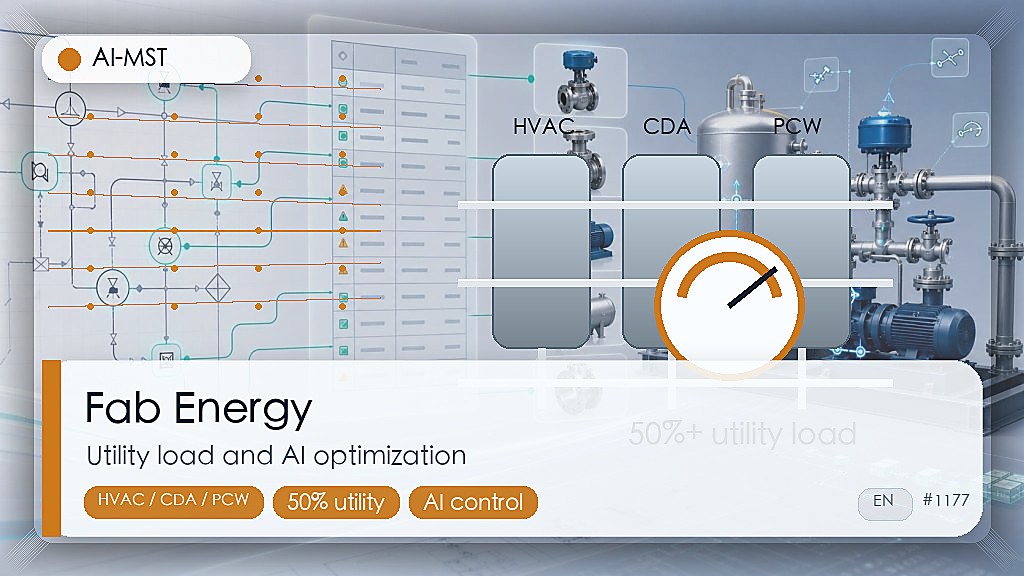
Key Takeaways
In a semiconductor fab’s power bill, only 40–50% goes to process tools. The other 50–60% is consumed by auxiliary systems (HVAC, compressed dry air, vacuum, process cooling water) — and these have historically been managed as “facilities engineering,” with no process-grade AI optimization. Based on multi-fab operational data, deploying a proper AI energy optimization platform can cut auxiliary-system consumption by 15–25% within 6–12 months. For a 100K wpm 8-inch fab, that’s USD 3–5 million in annual savings. MST NeuroEnergy targets this overlooked half of the fab’s power budget.
1. Where a fab’s electricity actually goes
Ask a fab manager what uses the most electricity and they’ll name etch, furnace, or CMP. That’s half right — process tools are the biggest single-unit consumers, but in aggregate they account for only 40–50% of total fab power. The other 50–60% sits in a set of systems most people forget:
| System | Share of fab power | AI optimization headroom |
|---|---|---|
| HVAC (cleanroom temperature/humidity) | 20–30% | 15–25% |
| Compressed dry air (CDA) / N₂ | 8–12% | 20–35% |
| Process cooling water (PCW) | 6–10% | 10–20% |
| Vacuum / scrubbers | 5–8% | 15–25% |
| Lighting / other | 3–5% | 5–10% |
A 100K wpm 300mm fab consumes roughly 120–150 GWh/year. At USD 0.10/kWh that’s USD 12–15 million annually, of which ~USD 6–7 million goes to auxiliaries. Even a conservative 20% optimization on that half saves USD 1.2–1.5 million per year — an ROI profile that beats most new process software introductions by an order of magnitude.
2. Why auxiliary systems still have no AI optimization
We asked facility managers at three mainland Chinese fabs and two Taiwanese fabs this exact question. The answers were remarkably consistent:
Reason 1: Process and facility data systems are siloed. Process tool data flows through SECS/GEM into MES/EDA; HVAC/CDA/PCW data flows through BMS (Building Management Systems) via Modbus/BACnet. The two stacks were never designed to interoperate. Result: you can’t easily answer “how much CDA did the etch fleet consume during last night’s high-volume window?”
Reason 2: The facility team’s KPI is “no downtime,” not “save money.” Their worst nightmare is cleanroom excursion causing a production halt. So the default strategy is extreme conservatism — temperature setpoint 22 ± 0.5°C but actual control band 21.5–22°C, oversized CDA pressure margins, PCW flows running above saturation. These conservative setpoints, baked in over decades, are now in SOPs nobody dares to touch.
Reason 3: Traditional energy consultants only do “tool-level” retrofits. Classical EMS vendors are good at VFD upgrades, high-efficiency motor swaps, pipe redesign. These are one-time hardware projects. But a fab’s real savings potential lies in dynamic scheduling — adjusting HVAC/CDA output to real production load instead of holding them at maximum 24/7. That requires software AI, not hardware retrofits.
3. Three layers of AI energy optimization
Layer 1: Visualization + anomaly detection (entry level)
Aggregate BMS + power meter + production data into a single platform with real-time dashboards and alerts. This layer solves the “invisibility” problem — a fab manager used to see only monthly reports; now they see per-minute compressed-air power draw and per-tool energy use.
Typical savings: 8–12% (mostly from finding leaks, idle tools, sensor drift). Deployment: 3–4 months.
Layer 2: Production-schedule-aware dynamic control (mainstream)
Connect MES production schedules to facility systems so HVAC/CDA modulate with production rhythm. Example: Sunday 3am maintenance window — CDA demand drops 60%, but conventional setpoints keep the system at full load. AI recognizes the pattern and scales back automatically.
Typical savings: 15–20% (cumulative with Layer 1). Deployment: 6–8 months. The hard parts are MES-BMS data integration and scheduling algorithms.
Layer 3: End-to-end predictive control (advanced)
Use MPC (model predictive control) or reinforcement learning for whole-fab optimization — predict the next 15 minutes of production load and external weather, solve for optimal HVAC/CDA setpoints. This is the cutting edge; TSMC and Intel have active programs here.
Typical savings: 20–25% cumulative. Deployment: 12–18 months. Requires a strong AI team collaborating with process engineers.
4. The real difficulty is data, not algorithms
Many teams assume AI energy optimization is an algorithm problem — hire a TensorFlow team, train a model, done. In practice 80% of the time goes into data:
Difficulty 1: BMS data quality is poor. Older fabs run a mix of BMS protocols (Modbus RTU, BACnet MS/TP, Siemens S7), many sensors are out of calibration, and sample rates range wildly from 5 seconds to 5 minutes. Step one is often a “sensor health audit.”
Difficulty 2: Time alignment between production and energy data. MES records “lot completed” events at minute resolution; BMS power data changes at second resolution. To compute “how many kWh went into this lot” requires second-level multi-source data fusion — a genuine engineering problem at older fabs.
Difficulty 3: Boundary conditions are complex. Cleanroom HVAC optimization must respect AMC (airborne molecular contamination), ACPH (air changes per hour), and cross-recipe contamination constraints. A pure “minimize energy” objective will violate process specs. This requires AI algorithms and process engineers working hand-in-hand — general-purpose AI teams cannot solve this alone.
5. How NeuroEnergy is positioned
MST NeuroEnergy is built specifically for semiconductor fab auxiliary-system optimization, differently from both traditional BMS vendors and generic EMS firms:
1. Semiconductor-process-native. We don’t do office building HVAC or data-center PUE — only semiconductor fabs. The product ships with standard data models for HVAC + CDA + PCW + vacuum, so customers don’t have to map 500+ tags themselves at deployment.
2. Deep MES integration. We read production data directly via SECS/GEM and MES/EDA interfaces instead of rebuilding a production view from BMS alone. This makes business-level metrics — “kWh per wafer lot” — available from month one.
3. Layered, incremental deployment. Customers can start at Layer 1 (visualization), see value in 3 months, then invest in Layer 2 and 3. No “big bang” project required.
4. Data plane shared with NeuroBox process AI. NeuroEnergy isn’t a standalone energy system — it shares a data layer with the E3200 VM/R2R stack, enabling correlation between “process parameter changes” and “energy consumption changes.” If an etch parameter tune causes CDA demand to rise 3%, only an integrated AI stack can reveal it.
6. ROI for a 100K wpm 300mm fab
- Layer 1 deployment (4 months): USD 1–1.3 million annual savings, payback < 6 months
- Layer 2 extension (8 months cumulative): USD 1.8–2.2 million annual savings
- Layer 3 complete (18 months cumulative): USD 2.6–3.2 million annual savings + 25% carbon footprint reduction (material for CBAM / ESG reporting)
Aside from yield improvement, this is one of the highest-ROI directions for fab-level AI investment — and it doesn’t compete with yield work; the two can run in parallel.
7. Three recommendations for fab facility leaders
Recommendation 1: Audit data first, talk AI second. Before any vendor conversation, spend a week on a BMS tag audit: how many tags exist? How many are dead? How many sample below spec? This groundwork lets you predict 80% of project risk upfront.
Recommendation 2: Start with CDA and vacuum, not HVAC. HVAC is the biggest slice but has the most complex boundary conditions — easy to trip a process compliance issue. Compressed air and vacuum have cleaner boundaries, 20–35% optimization headroom, and produce visible results fast. Good early wins to build team credibility.
Recommendation 3: Pull in IT and process teams early. Energy optimization will eventually touch MES interfaces and process SOPs. The earlier those teams are at the table, the fewer blockers you hit on data access and process boundaries later.
If you lead facility engineering or ESG at a fab, NeuroEnergy provides a staged path from data onboarding and visualization to end-to-end predictive control. A first PoC can target CDA alone and show results in 3–4 months. Book a 45-minute facility-focused technical review.
Related reading
- MES / EAP Architecture: A Data-Layer Design Guide for Semiconductor Fabs
- Where to Start with Semiconductor AI: VM, R2R, or DOE?
- AI-Driven Semiconductor Manufacturing: From Tools to Fab
NeuroBox E3200 replaces metrology wait with VM prediction. Auto-adapts control parameters. No manual tuning.
Learn about NeuroBox E3200 →这篇属于 NeuroBox D 设计自动化场景
获取一份 NeuroBox D 设计自动化评估,看看 P&ID 到 SolidWorks 原生装配体如何接入您的工程流程。
把 P&ID 图纸类型、客户零件库现状、3D 空间边界和装配规则发给我们。工程团队会先判断适合从哪一个机械设计环节切入,再给出落地建议。
- 适合设备商、气路/机械设计、CAD 自动化和工程复核团队
- 可从 P&ID、SolidWorks 零件库、装配规则和空间边界开始
- 优先评估旁接式本地 D 盒子,不要求上传机密图纸到公有云
Cut fab energy costs by 8-15% with AI energy management.