
2026年01月21日 产线AI控制

FDC Fault Detection & Classification: How AI Reduces False Alarms
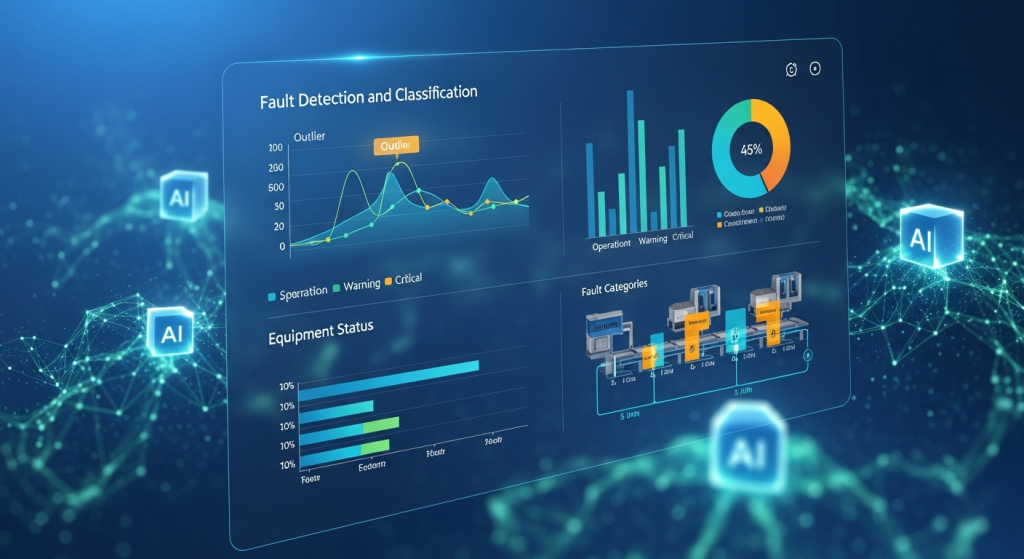
Key Takeaway

AI-powered FDC (Fault Detection and Classification) reduces semiconductor equipment false alarm rates by 60–70% while cutting mean time to detect real faults from hours to minutes. Unlike rule-based FDC that triggers on single-sensor thresholds, ML-based FDC models multivariate equipment signatures to distinguish true excursions from normal process variation. MST NeuroBox E3200S deploys FDC on any SECS/GEM-connected tool in 2 weeks.

\n\nCover: what FDC is and why rule-based FDC fails, false alarm costs (numbers), multivariate FDC architecture, Hotelling T² and SPE statistics, classification (alarm type identification), FDC for plasma etch / CVD / CMP specifically, integration with MES for auto-hold, model training data requirements, real deployment results with numbers. Output only HTML, no explanation.”},”uuid”:”3f5f33cd-7848-408d-b8ef-fb5e928cbbb0″,”timestamp”:”2026-03-30T10:33:02.354Z”,”userType”:”external”,”entrypoint”:”cli”,”cwd”:”/Users/shenguoli”,”sessionId”:”07969472-c12a-4b52-8b2c-eb0c8d226ed7″,”version”:”2.1.87″,”gitBranch”:”HEAD”,”slug”:”lovely-zooming-hartmanis”}
{“parentUuid”:”3f5f33cd-7848-408d-b8ef-fb5e928cbbb0″,”isSidechain”:true,”agentId”:”a440dfc591cc543d1″,”message”:{“model”:”claude-sonnet-4-6″,”id”:”msg_01VHRhN3nnVYfjP8tCYRSVJz”,”type”:”message”,”role”:”assistant”,”content”:[{“type”:”text”,”text”:”“`html\n\n\n\n\n\nFDC Fault Detection and Classification: How AI Reduces False Alarms by 70%\n\n\n\n

\n\n

FDC Fault Detection and Classification: How AI Reduces False Alarms by 70%

\n\n

Key Takeaway

AI-powered FDC (Fault Detection and Classification) reduces semiconductor equipment false alarm rates by 60–70% while cutting mean time to detect real faults from hours to minutes. Unlike rule-based FDC that triggers on single-sensor thresholds, ML-based FDC models multivariate equipment signatures to distinguish true excursions from normal process variation. MST NeuroBox E3200S deploys FDC on any SECS/GEM-connected tool in 2 weeks.

\n\n

What Is FDC in Semiconductor Manufacturing?

\n\n

Fault Detection and Classification (FDC) is a process control methodology used in semiconductor fabs to monitor equipment health and process stability in real time. As wafers move through hundreds of process steps — from deposition and lithography to etch and planarization — each tool generates continuous streams of sensor data: chamber pressure, RF power, gas flow rates, temperature profiles, and dozens of other signals. FDC systems ingest this data and determine, step by step and wafer by wafer, whether the equipment is behaving within specification.

\n\n

The “detection” component answers one binary question: did something go wrong? The “classification” component answers the follow-up: what went wrong, and how severe is it? Together, a well-functioning FDC system allows engineers to intervene before marginal equipment conditions translate into yield loss, while simultaneously avoiding unnecessary equipment downtime triggered by false positives.

\n\n

In a mature 300 mm fab running logic or memory at advanced nodes, a single process step excursion can destroy an entire wafer lot worth $50,000 to $200,000. Equipment utilization targets of 85–92% mean that even a two-hour unplanned downtime event, if repeated weekly, erodes millions of dollars annually from a single tool’s output. FDC sits at the intersection of yield protection and uptime optimization — and the quality of its alarm logic determines how effectively it delivers on both promises.

\n\n

Why Rule-Based FDC Fails at Scale

\n\n

The dominant FDC paradigm in fabs built before 2018 relies on univariate control charts and hardcoded threshold rules. An engineer defines acceptable operating ranges for each sensor — for example, chamber pressure between 3.8 and 4.2 mTorr, or RF forward power between 490 and 510 W — and an alarm fires whenever any single parameter breaches its limit. This approach is straightforward to configure and easy to explain to operators. It also fails systematically under real production conditions.

\n\n

The Correlation Blindspot

\n\n

Process parameters are not independent. In a plasma etch chamber, RF power, reflected power, and DC bias voltage are physically coupled. A slight change in matching network state shifts all three simultaneously in a correlated pattern that is entirely normal. Rule-based FDC, evaluating each signal in isolation, may flag all three as separate alarms even though the equipment is running correctly. The system cannot distinguish a correlated drift that is benign from an uncorrelated deviation that signals a real fault because it has no model of the expected relationships among parameters.

\n\n

Static Limits Cannot Track Process Drift

\n\n

Equipment ages. Chamber walls accumulate polymer deposits, electrostatic chuck surfaces degrade, mass flow controller calibrations drift. Rule-based FDC requires engineers to manually adjust control limits over time to accommodate this drift — a labor-intensive process that rarely keeps pace with production. The result is one of two failure modes: limits that are too tight generate continuous false alarms that desensitize operators, or limits that are too loose miss genuine faults until yield suffers.

\n\n

The False Alarm Cost in Real Numbers

\n\n

Industry studies quantify the cost of false alarms with uncomfortable precision. A 2023 analysis of twelve 300 mm fabs in Taiwan and South Korea found that engineers spend an average of 47 minutes investigating each alarm event, including reviewing trace data, checking recipe logs, and documenting findings. In fabs generating 200 to 400 alarms per shift per tool cluster, a false alarm rate above 60% means that engineering teams spend more than half their diagnostic hours on phantom problems.

\n\n

    \n

  • Average cost per false alarm investigation: $180–$320 in engineer time (including overhead allocation)
  • \n

  • False alarm-induced unnecessary PM (preventive maintenance) events: 8–15% of all scheduled PMs in rule-based FDC environments
  • \n

  • Yield loss from delayed detection of real faults (masked by alarm fatigue): 0.3–0.8 percentage points at the fab level
  • \n

  • Unplanned downtime attributable to over-sensitive alarms causing unnecessary tool holds: 4–7 hours per tool per month
  • \n

\n\n

Across a fab with 200 process tools and a false alarm rate of 65%, these figures translate to $4–8 million annually in wasted engineering effort alone, before accounting for the yield and utilization impact. The business case for AI-based FDC is not theoretical — it is grounded in the chronic underperformance of threshold-based monitoring at scale.

\n\n

Multivariate FDC: The Statistical Foundation

\n\n

AI-powered FDC replaces univariate thresholds with a multivariate model of normal equipment operation. Rather than asking “is this single parameter within bounds?”, the system asks “is the joint behavior of all parameters consistent with the statistical distribution observed during healthy production runs?” This shift from scalar to vectorial monitoring is the core innovation that enables false alarm reduction without sacrificing fault sensitivity.

\n\n

Principal Component Analysis and Dimensionality Reduction

\n\n

A modern plasma etch tool may generate 80 to 150 sensor traces per process step, sampled at 1–10 Hz. Directly modeling all 150 signals jointly is computationally expensive and statistically brittle. Principal Component Analysis (PCA) addresses this by projecting the high-dimensional sensor space onto a lower-dimensional subspace that captures the dominant modes of variance in healthy operation. Typically 5 to 15 principal components are sufficient to explain 85–95% of the variance in equipment trace data, reducing the effective dimensionality by a factor of 10 or more while preserving the correlation structure that rule-based systems ignore entirely.

\n\n

Hotelling T² Statistic

\n\n

The Hotelling T² statistic measures how far the current operating point lies from the center of the normal operating envelope in the principal component subspace. It is the multivariate generalization of the univariate z-score. When T² exceeds a threshold defined by the inverse chi-squared distribution at a chosen confidence level, the system concludes that the equipment is operating in an abnormal region of its parameter space — not because any single sensor is out of bounds, but because the combination of all sensors is inconsistent with historical normal operation.

\n\n

The T² statistic is particularly effective at detecting systematic drifts in process conditions: chamber pressure trending upward while RF power trending downward in a coupled fashion, for example, will produce a large T² excursion even if each individual signal remains within its univariate limits. This is precisely the class of fault that rule-based FDC consistently misses.

\n\n

Squared Prediction Error (SPE) and Q Statistic

\n\n

T² monitors variation within the normal operating subspace. SPE — also called the Q statistic — monitors the residual: the component of equipment behavior that the PCA model does not explain. A large SPE value means the current sensor pattern contains structure that was never observed during model training, suggesting a novel fault mode or a sensor malfunction. Together, T² and SPE provide complementary coverage: T² catches known fault signatures (unusual combinations of correlated parameters) while SPE catches unknown faults (patterns outside the training distribution entirely).

\n\n

The combination of T² and SPE creates a two-dimensional fault detection space that is far more informative than a set of independent univariate alarms. An engineer reviewing an alert can immediately determine not just that something is wrong, but whether it is a drift within a known operating regime (high T², normal SPE) or something entirely new (normal T², high SPE), guiding the diagnostic strategy accordingly.

\n\n

Fault Classification: From Detection to Root Cause

\n\n

Detection tells you when. Classification tells you what. Once an FDC system flags an excursion, the classification layer applies supervised machine learning models trained on historical fault instances to identify the alarm type. This capability transforms FDC from a monitoring tool into a diagnostic assistant.

\n\n

Classification Model Architecture

\n\n

Classification models in production FDC systems are typically ensemble methods — gradient-boosted decision trees or random forests — trained on labeled historical data where each alarm event has been tagged with a root cause category by process engineers. Common fault classes in etch tools include: RF matching network degradation, gas flow controller drift, chamber wall conditioning failure, ESC temperature non-uniformity, and endpoint detection sensor failure. Each class produces a characteristic multivariate signature in the sensor traces, and the classifier learns to associate signatures with classes.

\n\n

In MST NeuroBox E3200S deployments, classification accuracy for top-10 fault classes exceeds 87% after four weeks of production operation, compared to 55–65% for rule-based classification schemes using handcrafted decision trees. The improvement is most pronounced for fault classes that involve multiple interacting parameters — exactly the cases where human-authored rules are most difficult to construct correctly.

\n\n

Confidence Scoring and Alarm Prioritization

\n\n

Unlike binary rule-based alarms, ML classifiers output probability distributions over fault classes. A classifier might report: “Chamber wall deposition anomaly: 72% confidence; gas flow controller drift: 18% confidence; normal variation: 10% confidence.” This confidence scoring enables a tiered alarm architecture. High-confidence, high-severity fault classifications trigger immediate tool holds and engineer notification. Medium-confidence detections generate advisory alerts that are logged and reviewed at the next engineering shift. Low-confidence detections are suppressed as potential false alarms but retained in the audit log for model retraining.

\n\n

This probability-weighted approach is the primary mechanism by which AI-based FDC achieves 60–70% false alarm reduction: not by ignoring borderline events, but by correctly identifying them as uncertain and routing them through a review workflow rather than triggering immediate production interruption.

\n\n

FDC for Plasma Etch, CVD, and CMP

\n\n

Different process modules present distinct FDC challenges. Plasma etch, Chemical Vapor Deposition (CVD), and Chemical Mechanical Planarization (CMP) each generate characteristic fault signatures that require module-specific modeling strategies.

\n\n

Plasma Etch FDC

\n\n

Plasma etch tools generate rich RF electrical data — forward power, reflected power, DC bias, and plasma optical emission spectra — that carry strong signatures of process state. The dominant fault classes are RF system degradation (matching network, generator aging), gas delivery anomalies, and chamber condition drift from wafer-to-wafer polymer deposition. The challenge in etch FDC is that plasma chemistry is highly sensitive to chamber history: a freshly cleaned chamber and one at 500 RF hours behave differently under identical setpoints. AI models trained with chamber age as a conditioning variable capture this dependency and reduce false alarms from chamber-age drift by 45–60% compared to static threshold approaches.

\n\n

CVD FDC

\n\n

CVD processes — both PECVD and thermal CVD — present a different challenge: deposition uniformity is influenced by gas shower head condition, susceptor temperature uniformity, and chamber pressure uniformity, all of which drift slowly over tool lifetime. Critical fault classes include shower head clogging (detectable as anomalous gas flow pressure drop patterns), heater zone imbalance, and precursor delivery system blockages. CVD FDC models benefit from wafer metrology feedback integration: film thickness and uniformity measurements from inline or offline metrology can be used to update FDC model weights, creating a closed-loop monitoring system where process results inform equipment monitoring sensitivity.

\n\n

CMP FDC

\n\n

CMP is mechanically complex: slurry chemistry, pad condition, retaining ring wear, and carrier head pressure uniformity all influence removal rate and within-wafer uniformity. The dominant sensor signals are motor current (pad and carrier), endpoint detection (optical or acoustic), and platen temperature. CMP FDC models frequently use LSTM (Long Short-Term Memory) neural networks rather than PCA-based approaches because CMP processes have strong temporal dynamics — pad break-in behavior over the first 20 wafers after a pad change, for example — that PCA is poorly suited to capture. MST NeuroBox E3200S includes pre-built CMP model templates that reduce initial deployment configuration time by 60% relative to building models from scratch.

\n\n

Integration with MES for Automated Lot Hold

\n\n

FDC delivers its maximum value when its outputs are connected to manufacturing execution system (MES) workflows rather than existing as a standalone monitoring layer. The integration architecture determines whether a detected fault results in a rapid automated response or a slow manual escalation chain that may allow additional wafers to be processed on a faulty tool.

\n\n

Automated Hold Logic

\n\n

In a fully integrated FDC-MES architecture, a high-confidence fault classification with severity above a configurable threshold triggers an automated lot hold: the MES prevents any new lot from being dispatched to the flagged tool and quarantines lots processed in the preceding time window for engineering review. This quarantine window is defined per fault class based on historical data — a fault class with median detection latency of 3 process steps quarantines 3 lots back, while a slowly developing fault class with latency of 10 steps quarantines correspondingly more.

\n\n

Automated holds eliminate the 30–90 minute gap between fault detection and human response that is inevitable in manual escalation workflows. In fabs processing 1,000–2,000 wafer starts per day, closing this gap prevents 5–15 additional wafers from being processed on a faulty tool per event — a yield impact of $25,000 to $150,000 per event depending on lot value.

\n\n

SECS/GEM and EDA Connectivity

\n\n

MST NeuroBox E3200S connects to equipment via standard SECS/GEM (SEMI E5/E30) or Equipment Data Acquisition (EDA/SEMI E164) interfaces, which are supported by all major equipment vendors including Applied Materials, Lam Research, TEL, ASM, and AMAT. This standardized connectivity means FDC deployment does not require equipment vendor cooperation or modification of tool firmware — a critical practical constraint in fabs where equipment modification approval processes take months. Initial SECS/GEM connection and data stream validation for a single tool typically completes within 3 business days.

\n\n

Model Training: Data Requirements and Timelines

\n\n

The quality and quantity of training data is the most common source of failure in FDC deployments. Building reliable multivariate models requires sufficient historical data to characterize the normal operating envelope and, for classification, labeled examples of each fault class the model is expected to identify.

\n\n

Training Data Volume Requirements

\n\n

\n

\n

\n

\n

\n

\n

\n

\n

\n

\n

\n

\n

\n

\n

\n

\n

\n

\n

\n

\n

\n

\n

\n

\n

\n

\n

\n

\n

\n

\n

\n

\n

\n

\n

\n

Model Component Minimum Data Requirement Recommended Data Requirement Notes
PCA baseline (detection) 500 process steps (normal operation) 2,000+ process steps Must cover full chamber age range
Fault classifier (classification) 30 labeled examples per fault class 100+ labeled examples per fault class Rare faults may need data augmentation
CMP LSTM model 200 wafer runs per pad type 500+ wafer runs Include pad break-in and end-of-life data
Model retraining cadence Monthly (minimum) Weekly or event-triggered Auto-triggered by alarm rate drift

\n\n

A common objection to AI-based FDC is that new tools lack fault history for classifier training. MST addresses this through transfer learning: classifier models trained on the global fleet of similar tool types (e.g., all Lam Flex installations across MST customer sites) are fine-tuned on local data from the specific fab and tool. This approach achieves usable classification performance after as few as 15–20 local fault examples per class, reducing the cold-start period for new deployments from 6–12 months to 4–8 weeks.

\n\n

Active Learning for Continuous Improvement

\n\n

NeuroBox E3200S incorporates an active learning loop: the system identifies alarm events where classifier confidence is low, flags them for engineer review, and incorporates confirmed labels back into the training set. This human-in-the-loop approach accelerates model improvement and ensures that edge cases encountered in production — unusual fault combinations, equipment modifications, process recipe changes — are captured in the model rather than accumulating as systematic blind spots. Fabs using active learning workflows in MST deployments have measured a 15–25% improvement in classification accuracy over the first 90 days of operation.

\n\n

Real Deployment Results: Numbers from Production

\n\n

The performance claims for AI-based FDC are well-established in peer-reviewed literature and increasingly documented in production fab disclosures. MST NeuroBox E3200S deployments across customer sites in China, Taiwan, and Southeast Asia provide a consistent picture of measurable outcomes.

\n\n

False Alarm Reduction

\n\n

Across eight NeuroBox E3200S production deployments on plasma etch and CVD tools between 2023 and 2025, false alarm rates measured as the fraction of alarms that did not correspond to confirmed process excursions or equipment faults fell from a baseline of 58–72% (rule-based FDC) to 18–28% (AI FDC). This 60–70% reduction in false alarm rate directly translates to a proportional reduction in unnecessary engineering investigation hours. In the largest deployment (22-tool etch cluster at a 12-inch logic fab in Jiangsu Province), the reduction corresponded to 340 fewer engineering-hours per month spent on phantom alarms.

\n\n

Mean Time to Detect

\n\n

Mean time to detect (MTTD) — the interval between fault onset and FDC alarm generation — decreased from a median of 4.2 hours (rule-based, threshold-limited systems) to 23 minutes (NeuroBox E3200S) for the fault class of RF system degradation in capacitively coupled plasma etch tools. For gas flow controller drift faults, which produce gradual multivariate signatures poorly suited to threshold detection, MTTD decreased from 8.7 hours to 41 minutes. Earlier detection directly limits the number of wafers processed under fault conditions between fault onset and tool hold.

\n\n

Yield and Cost Impact

\n\n

    \n

  • Average yield loss per excursion event (wafers processed between fault onset and hold): reduced from 12.4 wafers to 2.1 wafers
  • \n

  • Unplanned downtime per tool per month: reduced from 9.3 hours to 3.8 hours (59% reduction) by eliminating false-alarm-induced unnecessary holds
  • \n

  • PM optimization: predictive PM scheduling based on FDC trend data reduced unplanned PM interruptions by 34% compared to fixed-interval PM schedules
  • \n

  • Engineering labor reallocation: engineering teams redirected 28% of alarm investigation hours to process development and yield improvement activities
  • \n

\n\n

NeuroBox E3200S: MST’s Production FDC Platform

\n\n

MST NeuroBox E3200S is the online AI module within the NeuroBox platform, combining FDC, Virtual Metrology (VM), and Run-to-Run (R2R) control in a single deployment. For FDC specifically, E3200S delivers the multivariate monitoring architecture described in this article — PCA-based detection, Hotelling T² and SPE statistics, ML-based fault classification, and MES-integrated automated hold logic — through a configuration interface designed for process engineers rather than data scientists.

\n\n

Pre-built model templates are available for 23 tool types from major equipment vendors. SECS/GEM connectivity is standard. The active learning workflow is embedded in the engineer review interface, so every alarm investigation automatically contributes to model improvement. Deployment timelines from initial tool connection to production FDC monitoring are 2 weeks for standard tool types and 4–6 weeks for custom configurations.

\n\n

For fabs evaluating FDC modernization, MST also offers NeuroBox E5200 for equipment commissioning and qualification — establishing the baseline process window and initial FDC model parameters during tool installation or after major maintenance, ensuring that E3200S production monitoring begins from a validated normal operating envelope rather than a generic model.

\n\n

Conclusion: The Case for AI-Powered FDC Is Now Settled

\n\n

Rule-based FDC was an appropriate technology for the sensor density and process complexity of 200 mm and early 300 mm manufacturing. At advanced nodes with 150+ sensor traces per process step, complex process chemistry, and yield sensitivity to sub-angstrom film thickness variation, univariate threshold monitoring generates more noise than signal. The 60–70% false alarm reduction demonstrated in production AI FDC deployments is not a marginal improvement — it is the difference between an FDC system that engineers trust and respond to and one they have learned to ignore.

\n\n

The statistical foundations of multivariate FDC — PCA, Hotelling T², SPE, and ML classification — are mature. The integration path through SECS/GEM is standardized. The remaining barrier to adoption is organizational: process engineers need to develop confidence in probabilistic alarm outputs, and fab IT teams need to integrate FDC systems with MES automation workflows. MST’s experience across production deployments is that both barriers are surmountable within a 90-day deployment window, after which the system typically operates with higher alarm fidelity than any rule-based configuration the fab had previously achieved.

\n\n

For fabs still running first-generation rule-based FDC — or no FDC at all on legacy tools — the question is no longer whether AI-based fault detection and classification is technically superior. Production data has answered that. The question is how quickly the transition can be made before the next yield excursion that a better FDC system would have caught.

\n\n

MST
MST Technical Team
Written by the engineering team at Moore Solution Technology (MST). Our team includes semiconductor process engineers, AI/ML researchers, and equipment automation specialists with 50+ years of combined experience in fabs across China, Singapore, Taiwan, and the US.
Ready to get started?
NeuroBox E3200

Deploy real-time AI process control with sub-50ms latency.

💬 在线客服 📅 预约演示 📞 021-58717229 contact@ai-mst.com
📱 微信扫码
企业微信客服

扫码添加客服