
MTBF & MTTR: AI-Powered Equipment Reliability Optimization
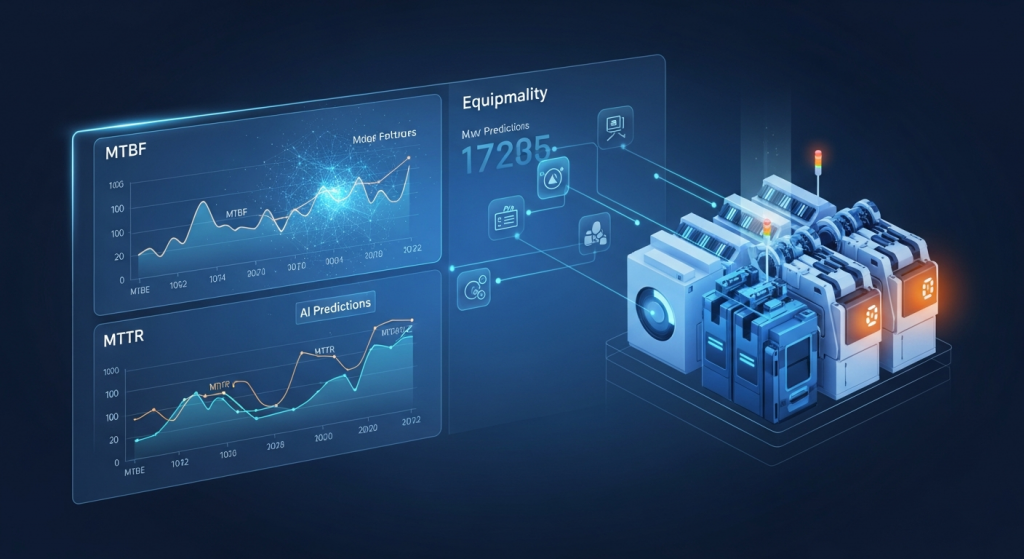
Key Takeaway
AI-driven reliability optimization increases MTBF by 25–40% and reduces MTTR by 50–65% in semiconductor equipment — translating directly to 8–15% improvement in tool OEE. NeuroBox monitors real-time health indicators to predict failures 24–72 hours before occurrence, giving maintenance teams time to prepare parts and schedule downtime during non-peak production windows.
Semiconductor equipment reliability is not an abstract engineering goal — it is a direct determinant of wafer output, cycle time, and cost per die. Yet in most fabs today, reliability management remains anchored to reactive practices: equipment breaks, an alarm fires, engineers scramble, and the line stops. The gap between what is possible and what is practiced is enormous, and it is precisely where artificial intelligence is delivering measurable returns.
This article covers the foundations of MTBF and MTTR, their relationship to Overall Equipment Effectiveness, the limitations of conventional reliability programs, and how AI-based prediction architectures are closing the gap — with specific examples drawn from real equipment types and real fab results.
Defining MTBF and MTTR: The Foundation of Equipment Reliability
Mean Time Between Failures (MTBF) measures the average operating time between two consecutive unplanned failures of a repairable system. It is calculated as:
MTBF = Total Uptime / Number of Failures
For example, if an etch tool runs for 4,000 hours over a quarter and experiences 8 unplanned failures, its MTBF is 500 hours. A higher MTBF means fewer interruptions per unit of production time.
Mean Time To Repair (MTTR) measures the average time required to restore a failed system to operational status. It includes fault detection time, diagnostic time, parts procurement time, repair execution time, and qualification/recommissioning time:
MTTR = Total Downtime for Repairs / Number of Repairs
Using the same tool above: if those 8 failures resulted in a combined 320 hours of downtime, MTTR is 40 hours per incident. Reducing MTTR from 40 hours to 15 hours — a 62.5% reduction — recovers 200 hours of productive capacity per quarter from a single tool.
These two metrics are frequently discussed in isolation, but their combined effect on tool availability is what matters to production:
Availability = MTBF / (MTBF + MTTR)
Using the example above: 500 / (500 + 40) = 92.6%. If MTBF improves to 650 hours and MTTR drops to 15 hours, availability climbs to 97.7% — a 5.1 percentage point gain that compounds across every tool in the fleet.
How Reliability Feeds OEE: The Availability Component
Overall Equipment Effectiveness (OEE) is the product of three factors:
OEE = Availability × Performance × Quality
Availability is typically the largest single lever for OEE improvement in mature semiconductor fabs where performance rates are already optimized and quality yields are tightly controlled. A tool running at 93% availability, 97% performance, and 99% quality achieves OEE of 89.4%. Improving availability to 97.7% — with performance and quality held constant — raises OEE to 93.9%, a 4.5 percentage point gain.
For a critical path tool processing 200 wafers per day at $1,500 per wafer, that 4.5-point OEE gain represents approximately $1.35 million in annual incremental output capacity per tool. In a fab with 30 critical-path tools, the aggregate value is substantial enough to justify a dedicated reliability optimization program with significant investment in instrumentation and AI infrastructure.
Traditional Reliability Approaches and Their Limitations
Most fabs rely on one or more of the following conventional reliability strategies:
Time-Based Preventive Maintenance (PM): Maintenance is performed on fixed schedules — every N wafers processed or every N days — regardless of actual equipment condition. This approach has two opposing failure modes: over-maintenance (replacing components that still have useful life remaining, incurring unnecessary cost and downtime) and under-maintenance (intervals set too conservatively miss accelerating degradation). Studies across semiconductor fabs consistently find that 30–45% of PM activities are performed either too early or too late to be optimal.
Reactive Maintenance: Equipment runs until failure. This may appear economical for non-critical tools but creates unpredictable downtime, parts shortages, and cascading schedule disruptions when it affects bottleneck tools. Recovery time is compounded by diagnosis uncertainty — engineers arriving at a failed tool with no prior context must reconstruct what happened from post-failure data.
Condition-Based Monitoring with Manual Thresholds: Sensor data is collected, and alarms trigger when values cross static limits. This is better than pure reactive maintenance but suffers from a fundamental limitation: by the time a sensor reading crosses a hard threshold, failure is often imminent or has already begun. Single-parameter alarms also generate high false-positive rates — nuisance alarms that erode engineer trust and lead to alarm fatigue.
The unifying limitation across these approaches is that none of them exploit the full information content of the sensor data being collected. Modern semiconductor equipment generates tens to hundreds of sensor channels at sub-second sampling rates. Traditional approaches monitor perhaps 5–15 of these channels against static limits, discarding the multivariate temporal patterns that are the earliest and most reliable indicators of impending failure.
AI Failure Prediction Architecture: From Sensor Features to Remaining Useful Life
AI-based predictive maintenance systems exploit the full sensor data stream through a multi-stage architecture.
Stage 1 — Data Collection and Feature Engineering: Raw sensor streams (temperature, pressure, flow, power, voltage, impedance, vibration, acoustic emission, and process outcome metrics like etch rate or deposition uniformity) are ingested at high frequency. Feature engineering transforms raw time-series data into health indicators: moving averages, rate-of-change, inter-sensor correlations, frequency-domain features from FFT analysis, and recipe-normalized values that account for process-induced variation. A typical etch tool may generate 150–300 engineered features per wafer run.
Stage 2 — Anomaly Detection: Unsupervised models establish the baseline distribution of normal behavior across the feature space. Mahalanobis distance, isolation forest, and autoencoder reconstruction error are commonly used approaches. Deviations from the normal distribution are flagged as anomalies — not necessarily failures, but departures from expected behavior that warrant investigation or monitoring. This layer is particularly valuable for detecting novel failure modes not present in historical labeled data.
Stage 3 — Failure Mode Classification: Supervised classification models trained on historical labeled failures assign incoming anomalies to specific failure mode categories. For an etch tool, this might include RF generator degradation, electrostatic chuck (ESC) charging anomaly, process kit deposition buildup, or gas delivery drift. Classification models require sufficient historical failure examples and are most powerful in mature, well-instrumented tool fleets with years of operational history.
Stage 4 — Remaining Useful Life (RUL) Estimation: Survival models — including Cox proportional hazards models and deep learning approaches such as temporal convolutional networks and transformer architectures — estimate the probability distribution of time to failure given the current equipment state and degradation trajectory. This output, expressed as “estimated hours remaining before failure with 80% confidence,” is the operational heart of a predictive maintenance program. It allows maintenance planners to answer the question: “Do I need to act before the next scheduled maintenance window, or can this wait?”
Stage 5 — Maintenance Action Recommendation: The RUL estimate feeds a decision layer that accounts for production schedule, spare parts inventory, technician availability, and the cost of scheduled versus unscheduled downtime. The output is a prioritized work order with recommended action, urgency level, and parts list — not just an alert that something may go wrong.
Failure Modes by Equipment Type: Where AI Adds the Most Value
The specific failure modes targeted by AI prediction vary by equipment type. Understanding these helps prioritize instrumentation investment and model development.
Plasma Etch Equipment: The RF generator is the most common high-impact failure mode, with degradation manifesting as forward power instability, impedance matching drift, and reflected power spikes. AI models tracking RF match position, forward/reflected power ratio, and plasma impedance can detect generator degradation 48–96 hours before catastrophic failure. Electrostatic chuck (ESC) failures — chuck voltage drift, temperature non-uniformity, arcing events — are the second major failure category and are detectable through chuck current monitoring, wafer temperature uniformity trends, and process outcome correlation. Process kit components (focus rings, edge rings, liners) exhibit gradual deposition buildup that shifts etch profiles predictably; AI models correlating DC bias drift with kit age provide accurate end-of-life prediction without requiring optical emission spectroscopy.
CVD / ALD Equipment: Heater failures in thermal CVD systems account for a disproportionate share of unplanned downtime due to the high thermal stress and the difficulty of replacing heater assemblies without a full chamber clean cycle. Temperature uniformity maps generated from multi-zone heater telemetry enable AI models to detect developing heater element failures before they affect process uniformity. Showerhead blockage — gradual deposition reducing hole diameter and altering gas distribution — is detectable through pressure drop trends and process uniformity changes. Chiller and heat exchanger fouling follows predictable degradation curves in delta-temperature data that are straightforward to model with regression-based RUL estimators.
CMP Equipment: The platen and head motor systems generate rich vibration signatures that change characteristically as bearings degrade, slurry abrasive accumulates in drive components, or pad conditioning disk wear alters the cutting action. AI vibration analysis — particularly spectral analysis of motor current and accelerometer data — provides 24–48 hours of advance warning for most mechanical failures. Slurry system failures (nozzle clogging, flow controller drift, temperature deviations) are detectable through process outcome monitoring: removal rate trends and within-wafer non-uniformity are sensitive leading indicators of slurry system health that degrade measurably before the system fails outright.
Spare Parts Optimization Using Predicted Failure Time
One of the less-discussed but financially significant benefits of AI-based predictive maintenance is its impact on spare parts inventory. Traditional spare parts models use statistical safety stock calculations based on historical failure rates and lead times, typically resulting in either chronic stockouts (for rare but critical parts) or excessive on-hand inventory tying up capital.
When the AI system provides a probabilistic RUL estimate — for example, “RF generator on Tool E14 has a 70% probability of failure within 72 hours” — procurement can initiate an emergency order or pull from a regional buffer stock with confidence that it will be needed. Over time, as prediction accuracy accumulates, fabs can reduce safety stock for high-confidence predictions by 20–35% while simultaneously reducing stockout events for predicted failures to near zero.
This dynamic parts management capability also enables just-in-time kitting for scheduled PM activities. Rather than maintaining full PM kits for every tool in perpetuity, the AI system’s component RUL estimates can drive a pull-based parts system where replacement components are ordered 1–2 weeks before their predicted end of life, reducing capital tied up in idle inventory.
Maintenance Window Scheduling: Aligning Downtime with Production
The RUL probability distribution enables a class of scheduling optimization that is impossible with reactive or time-based maintenance: aligning equipment downtime with production slack.
In a typical 300mm fab, production schedules have natural low-throughput windows — shift transitions, scheduled tool qualification periods, engineering lot priorities — where the cost of one additional tool being offline is substantially lower than during peak production runs. If the AI system predicts that a component has a 90% probability of failure within 96 hours, the maintenance planning system can search the next 96-hour production window for the lowest-cost 4-hour maintenance slot and schedule the repair proactively.
This approach eliminates the worst-case scenario: an unplanned failure during a high-volume production run on a bottleneck tool, where each hour of downtime may affect dozens of wafers in queue and trigger downstream schedule cascades. Even if the proactive maintenance adds some time compared to what the part’s remaining life would have allowed, the certainty and schedule alignment more than compensate.
NeuroBox integrates directly with fab MES and scheduling systems to surface these optimization opportunities in real time, presenting maintenance planners with a ranked list of recommended actions, predicted urgency, and suggested scheduling windows — without requiring manual analysis of raw sensor data or RUL model outputs.
Real Fab Results: Before and After MTBF Numbers
Across NeuroBox deployments in semiconductor fabs, the reliability improvement data shows consistent patterns by equipment category.
For plasma etch tools, pre-deployment MTBF averages in the range of 280–350 hours are typical for mature process nodes where PM intervals have been extended to maximize throughput. After 6–9 months of AI-driven predictive maintenance — with maintenance actions guided by RUL estimates rather than fixed intervals — MTBF in the range of 420–490 hours is achievable, representing 35–45% improvement. MTTR reductions are equally significant: pre-deployment average MTTR of 18–24 hours (including parts logistics) drops to 7–10 hours when technicians arrive with the correct parts already staged and a pre-diagnosis of the likely failure mode.
For CVD tools, where PM intervals are already fairly aggressive due to high deposition byproduct accumulation, the primary gain comes from reducing unnecessary PM events rather than extending intervals. AI models that accurately distinguish between “kit has reached the deposition threshold that actually affects process quality” versus “kit is at the scheduled wafer count but process performance is still in spec” allow 15–25% of PM events to be safely deferred, recovering thousands of hours of productive time annually across a large fleet.
For CMP tools, unplanned downtime from mechanical failures — historically the dominant downtime driver — decreases by 50–70% in mature deployments. The remaining unplanned downtime shifts toward chemical and consumable-related events that are more difficult to predict from equipment sensors alone without process outcome correlation.
The aggregate effect across tool types is an 8–15% OEE improvement attributable to the reliability component alone — not counting the additional gains from reduced process variation and improved yield that accompany better equipment health management.
Implementing AI Reliability Optimization: A Practical Roadmap
Fabs considering AI-based reliability optimization should approach implementation in phases. Phase one focuses on data infrastructure: ensuring high-quality, low-latency sensor data collection with consistent time-stamping and equipment context (tool ID, chamber, recipe, lot). Gaps in data quality at this stage propagate into model uncertainty downstream. Phase two focuses on building the labeled failure dataset — this requires systematic documentation of failure events with associated pre-failure sensor data, which is often the most time-consuming part of the program. Phase three deploys anomaly detection and failure mode classification models, initially in monitoring mode without taking maintenance actions. Phase four begins integrating model outputs into maintenance workflows, starting with the highest-impact tool types. Full integration with MES and scheduling systems typically occurs in phase five.
NeuroBox accelerates this timeline by providing pre-built feature libraries for common semiconductor equipment types, transfer learning from cross-fab failure mode databases, and a standard MES integration layer — reducing typical time to first production deployment from 12–18 months to 3–5 months.
Conclusion
MTBF and MTTR are simple metrics that summarize a complex operational reality: the difference between a semiconductor fab that consistently delivers promised output and one that manages a constant cycle of unplanned disruptions. AI-powered predictive maintenance does not eliminate equipment failures — it anticipates them, schedules response appropriately, and transforms the economics of reliability management from a cost center into a competitive advantage. The technology is mature, the ROI is documented, and the implementation path is well-defined. For fab engineers and operations leaders evaluating where to focus improvement energy, reliability optimization through AI prediction deserves to be at the top of the list.
这篇属于 NeuroBox D 设计自动化场景
获取一份 NeuroBox D 设计自动化评估,看看 P&ID 到 SolidWorks 原生装配体如何接入您的工程流程。
把 P&ID 图纸类型、客户零件库现状、3D 空间边界和装配规则发给我们。工程团队会先判断适合从哪一个机械设计环节切入,再给出落地建议。
- 适合设备商、气路/机械设计、CAD 自动化和工程复核团队
- 可从 P&ID、SolidWorks 零件库、装配规则和空间边界开始
- 优先评估旁接式本地 D 盒子,不要求上传机密图纸到公有云
Discover how MST deploys AI across semiconductor design, manufacturing, and beyond.