
APC Guide: Understanding VM, R2R, and FDC in Semiconductor Manufacturing
Key Takeaway
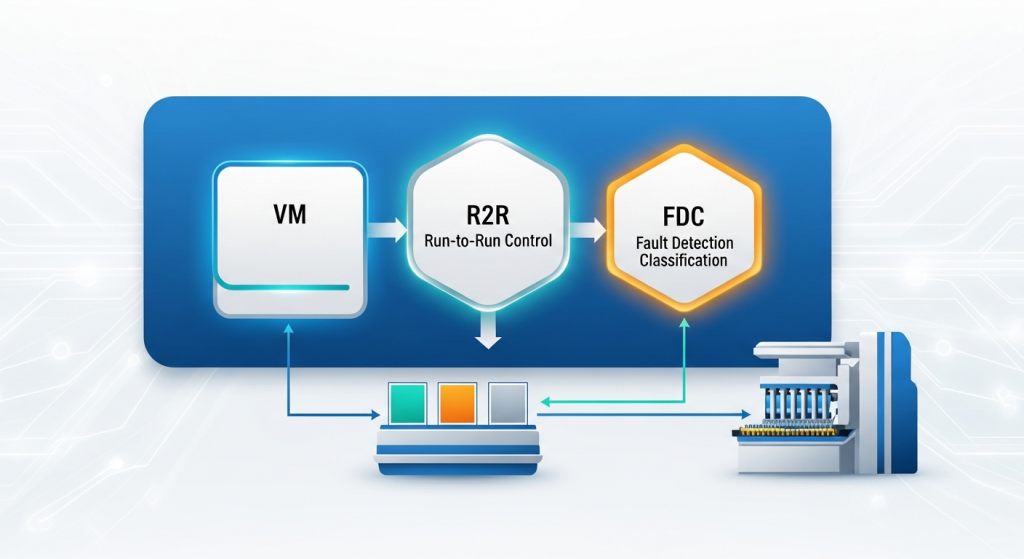
APC (Advanced Process Control) has 3 pillars: VM for prediction, R2R for control, FDC for detection. Together they improve yield by 3-8% and reduce metrology costs by 60-80%. NeuroBox E3200 integrates all three in a single edge AI platform.
APC (Advanced Process Control) is one of the core technologies for improving yield and throughput in wafer fabs. In advanced nodes below 7nm, the process window has become so narrow that traditional SPC (Statistical Process Control) can no longer meet precision requirements, making APC an indispensable capability.
What Is APC?
APC is a system architecture for real-time process parameter control. Its core objective is to ensure that every wafer receives optimal process parameters at every step. APC typically comprises three layers:
| Layer | Technology | Function |
|---|---|---|
| Sensing Layer | FDC (Fault Detection & Classification) | Real-time monitoring of equipment status and process parameters to identify anomalies |
| Prediction Layer | VM (Virtual Metrology) | AI-based prediction of wafer quality, partially replacing physical metrology |
| Control Layer | R2R (Run-to-Run Control) | Automatic adjustment of process parameters for the next wafer based on results from the previous one |
The Business Value of APC in Wafer Fabs
- Yield improvement: Real-time compensation of process drift via R2R can boost yield by 3-8%
- Metrology cost reduction: VM replaces 60-80% of physical metrology, freeing up metrology tool capacity
- Early anomaly detection: FDC enables real-time monitoring, reducing anomaly response time from hours to seconds
- Process consistency: Significant improvement in process uniformity across multiple tools and chambers
Traditional APC vs. AI-Driven APC
Traditional APC relies primarily on linear models and statistical methods (such as EWMA controllers), which work well when process relationships are straightforward. However, as advanced nodes introduce nonlinear, multi-variable coupling challenges, the limitations of traditional approaches become increasingly apparent.
AI-driven APC replaces linear models with deep learning, enabling:
- Capture of nonlinear relationships among process parameters
- Adaptive learning with continuous model optimization as data accumulates
- Small-sample modeling — no need for tens of thousands of historical wafers; 10-15 wafers are sufficient to build an effective model
- Edge-based real-time inference, completing prediction and control decisions within 50ms
NeuroBox E3200: An Edge AI Solution for the Fab
MST Semiconductor’s NeuroBox E3200 is an edge AI agent purpose-built for wafer fabs. It integrates the three core APC functions — VM, R2R, and FDC — in a plug-and-play form factor, requiring no modifications to existing MES systems.
Learn more: NeuroBox E3200 Product Details | More Technical Articles
读完这篇,下一步可以很具体
获取一份产线 AI 评估,看看 NeuroBox E3200 / SECS/GEM 怎么接到您的设备。
把设备类型、当前数据接口、工艺目标或良率问题发给我们。工程团队会先判断适合 VM、R2R、Smart DOE、EIP 还是能源优化,再给出下一步建议。
- 适合晶圆厂、设备商、工艺/设备/自动化团队
- 可从 SECS/GEM、Modbus、PLC、CSV/历史数据开始
- 不需要先提交机密 recipe 或客户图纸
Deploy real-time AI process control with sub-50ms latency.