
FDC Fault Detection & Classification: How AI Reduces False Alarms
Key Takeaway
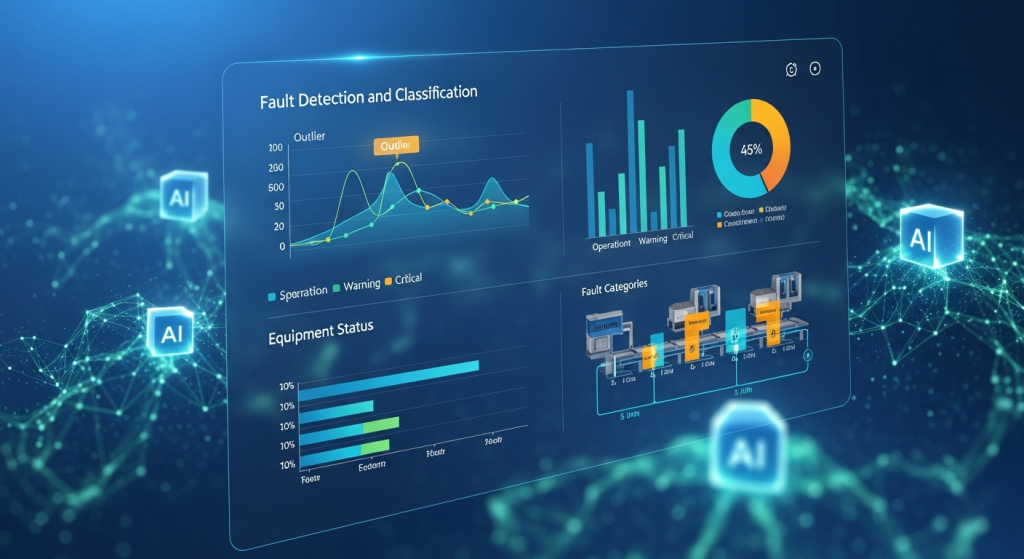
Fault Detection and Classification (FDC) helps fabs identify abnormal equipment behavior before it becomes scrap or downtime. AI-based FDC reduces nuisance alarms by learning normal operating patterns, ranking root-cause candidates, and connecting alarms to process impact instead of treating every threshold crossing as equal.
Why traditional FDC creates too many alarms
Semiconductor equipment generates thousands of signals: temperature, pressure, RF power, gas flow, valve state, endpoint traces, motor current, and recipe events. Conventional FDC systems normally use static control limits for each signal. This is easy to configure, but it creates a serious operational problem: a single healthy recipe can trigger many harmless limit violations, while a subtle multi-signal drift may pass undetected.
The result is alarm fatigue. Engineers learn to ignore repeated warnings, response time slows down, and the most important alarm can be buried in a long list of low-value events. In high-volume manufacturing, false alarms are not just inconvenient; they consume engineering capacity and can delay real excursion response.
How AI improves fault detection
AI-based FDC models the relationship between signals instead of judging every variable independently. For example, chamber pressure, throttle valve position, RF power, and gas flow should move together in predictable ways during each recipe step. If one signal is still within its static limit but its relationship to the other signals becomes abnormal, the model can flag early drift.
A practical FDC model usually combines three layers: step-aware feature extraction, anomaly scoring, and classification. Step-aware extraction aligns sensor data to recipe phases. Anomaly scoring detects abnormal patterns. Classification maps those patterns to likely causes such as MFC drift, ESC temperature instability, RF matching degradation, vacuum leak, endpoint delay, or chamber seasoning change.
From alarm list to root-cause workflow
The value of AI FDC is not only detecting faults earlier. The larger value is prioritization. A good system tells the engineer which alarms are probably noise, which alarms are process-critical, and which equipment subsystem should be checked first. This changes FDC from a passive alarm board into an active decision-support tool.
For production deployment, fabs should start with a limited set of high-value modules and failure modes. Build a baseline from stable lots, validate false-positive rate, connect the model to metrology or yield outcomes, and only then expand to more chambers and recipes. The model should be monitored continuously because preventive maintenance, consumable replacement, and recipe changes can all shift the normal operating envelope.
Implementation checklist
- Collect high-frequency tool traces with recipe step markers.
- Separate normal production, maintenance, engineering lots, and known excursions.
- Build chamber-specific and recipe-aware baselines.
- Track false alarms, missed alarms, and engineer response time.
- Integrate alarm ranking into the existing MES, EAP, or engineering dashboard.
When deployed carefully, AI FDC reduces noise, shortens diagnosis time, and helps engineers focus on the few signals that actually matter for yield and uptime.
读完这篇,下一步可以很具体
获取一份产线 AI 评估,看看 NeuroBox E3200 / SECS/GEM 怎么接到您的设备。
把设备类型、当前数据接口、工艺目标或良率问题发给我们。工程团队会先判断适合 VM、R2R、Smart DOE、EIP 还是能源优化,再给出下一步建议。
- 适合晶圆厂、设备商、工艺/设备/自动化团队
- 可从 SECS/GEM、Modbus、PLC、CSV/历史数据开始
- 不需要先提交机密 recipe 或客户图纸
Deploy real-time AI process control with sub-50ms latency.