
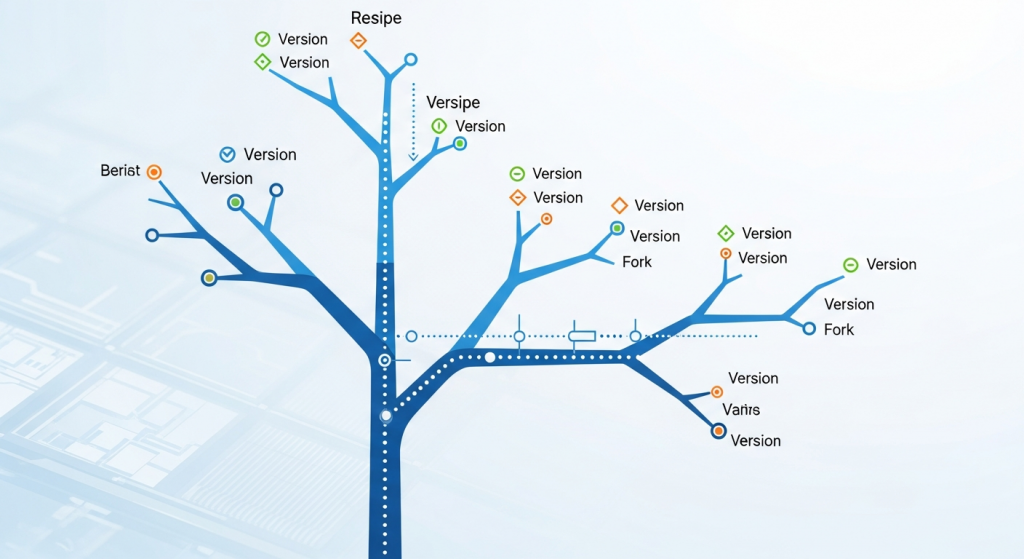
Recipe Management: The Pain and Solutions of Process Recipe Version Control
In a semiconductor fab, the recipe is where everything begins. A recipe defines the complete set of parameter settings for a given process step: temperature, pressure, gas flow, time, power… It is the crystallization of engineering expertise and the backbone of production consistency. Yet for most fabs, recipe management remains an area that is “acknowledged as important but practiced chaotically.” This article examines the common pain points of recipe management and explores how digitalization and AI technologies can help fabs establish a systematic recipe management framework.
1. Pain Points: The State of Recipe Management Chaos
If you have ever worked in a fab, the following scenarios are surely familiar:
1.1 Version Confusion
“When was this recipe changed? Who changed it? What was changed?” — This is arguably one of the most frequently heard existential questions in a fab.
A typical etch recipe may undergo dozens of modifications during its production lifetime: fine-tuning temperature to compensate for process drift, adjusting step times for a new product, modifying gas flow to resolve a yield issue… Each modification may create a new version, but version naming conventions are all over the map: V1, V2, V2_new, V2_final, V2_final_really_final. After a few months, no one can say which version corresponds to which change.
1.2 Change Traceability Challenges
When yield suddenly drops, engineers need to trace recent changes. But in many fabs, recipe change records are scattered across different systems, emails, and even engineers’ notebooks. Worse, some changes are made directly on the equipment controller, leaving no record at all.
Without a complete change audit trail, every yield issue risks becoming a detective game — everyone guesses from memory “who touched this recipe last week.”
1.3 Cross-Tool Inconsistency
The same process step may be deployed on multiple tools of the same model. In theory, they should all use the same recipe, but in practice, each tool may have its own “customized version” — tweaks made for Chamber Matching, workarounds for tool-specific issues. Over time, the recipe on each tool becomes a “one-of-a-kind,” completely losing version consistency.
1.4 Knowledge Fragmentation
The process know-how behind recipe parameters often exists only in the heads of senior engineers. Why is this temperature 350 degrees C and not 360 degrees C? What was the rationale behind that decision? Where is the experimental data? If this information is not systematically documented, it is lost the moment the engineer leaves or transfers.
2. Traditional Methods: The Era of Excel and Paper Records
In many fabs, the actual practice of recipe management remains at a remarkably primitive level:
- Excel spreadsheets: Shared Excel files are used to record recipe parameters and change history. But multi-user collaboration leads to frequent version conflicts, inconsistent formats, and difficult searches.
- Paper change forms: Each recipe change requires filling out a paper approval form, signing, and archiving. The problem is that retrieval is time-consuming, and paper records cannot be linked to electronic data.
- Email notifications: Recipe changes are communicated via email to relevant personnel. But emails are easily overlooked and contain unstructured data that cannot be systematically searched or analyzed.
- Equipment-side management: Some engineers manage recipe versions directly on the equipment controller, but each tool’s interface and storage methods differ, making standardization impossible.
These methods are barely adequate when the fab is small and product variety is limited. But when a fab scales to hundreds of tools and thousands of recipes, manual management methods inevitably collapse.
3. Digital Solution: Version Control + Change Approval + Impact Analysis
The first step to solving recipe management problems is digitalization — establishing a unified recipe management platform. A qualified recipe management system should provide the following core capabilities:
3.1 Version Control
Drawing from the mature version control concepts of the software industry (such as Git), a complete version tree is built for each recipe:
- Unique version numbering: Each change automatically generates a unique version number, eliminating naming confusion.
- Diff comparison: Any two versions can be compared with a single click, with differences pinpointed down to each parameter change.
- Branch management: Supports creating branches from any version for experimental modifications, which are merged back to the mainline after validation.
- Rollback capability: Any previous version can be restored with a single click at any time.
3.2 Change Approval Workflow (Change Control)
All recipe changes must go through a standardized approval process:
- Change request: The engineer submits a change request in the system, describing the change content, rationale, and expected effect.
- Technical review: Designated approvers review the change for validity and risk.
- Approved execution: Upon approval, the system automatically deploys the new version to the designated equipment.
- Effect tracking: After the change, the system automatically collects a defined amount of process data to evaluate the actual effect.
The key is that this workflow must be fully online — all steps completed within the system, automatically generating a complete audit trail that satisfies FDA 21 CFR Part 11 or similar compliance requirements.
3.3 Change Impact Analysis
The ultimate purpose of a recipe change is to improve process performance. The system should support automated before-and-after comparison analysis:
- Statistical comparison of quality metrics before and after the change (mean, standard deviation, Cpk)
- Comparison of sensor signals before and after the change (to detect hidden changes)
- Assessment of the change’s impact on downstream process steps
These analysis results are automatically linked to the change record, forming a closed loop of knowledge accumulation.
4. AI Enhancement: Recipe Recommendation and Similarity Search
Building on the digital management foundation, AI can further elevate the intelligence of recipe management:
4.1 Recipe Recommendation
When engineers need to develop a recipe for a new product or process, AI can recommend optimal starting parameter combinations based on the existing recipe library and process data:
- Based on similar products: Analyze the new product’s process requirements (such as target film thickness, material type, pattern features) and retrieve the most similar recipes from existing products as a starting point.
- Based on process models: Use process models trained on existing data to predict parameter ranges that meet target metrics.
- Parameter sensitivity guidance: Inform engineers which parameters are most sensitive to the target metrics, so prioritizing these parameters yields faster results.
4.2 Similar Recipe Search
Fabs often contain a large number of functionally similar but slightly different recipes (customized versions for different tools or products). AI can use semantic similarity analysis to help engineers quickly find related recipes:
- “Find all recipes with greater than 90% parameter similarity to this recipe” — to discover unnecessary redundancy.
- “Find all recipes where the temperature parameter was changed in the past 3 months” — to assist in troubleshooting.
- “Find recipes targeting the same process across different tools, and compare the differences” — to assist in standardization.
4.3 Anomaly Detection and Compliance Auditing
AI continuously scans the recipe library and automatically detects potential issues:
- Parameter out-of-bounds alert: A recipe parameter exceeds the equipment’s safe operating range.
- Long-dormant alert: A recipe has not been used or updated for an extended period and may be obsolete.
- Inconsistency alert: Recipe differences for the same process step across different tools exceed the expected range.
- Compliance check: Automatically verifies that all active recipes have gone through the proper approval process.
5. Building a Recipe Knowledge Base
The ultimate goal of a recipe management system is not just to manage current recipes, but to transform process know-how into reusable organizational knowledge. Every recipe change is a process experiment. The system should store the change context (rationale, experimental data, effect evaluation) in a structured manner, progressively building the fab’s process knowledge base.
When a new engineer encounters a recipe, they can see not only the current parameter settings but also how each parameter evolved to its current state and the background and results of every change. This is knowledge preservation — no longer dependent on any individual’s memory, but embedded in the system.
Manage Your Recipes with an Intelligent System
NeuroBox E3200 delivers not only real-time process control but also integrates recipe version management and intelligent recommendation capabilities, helping fabs build a systematic process knowledge base.