
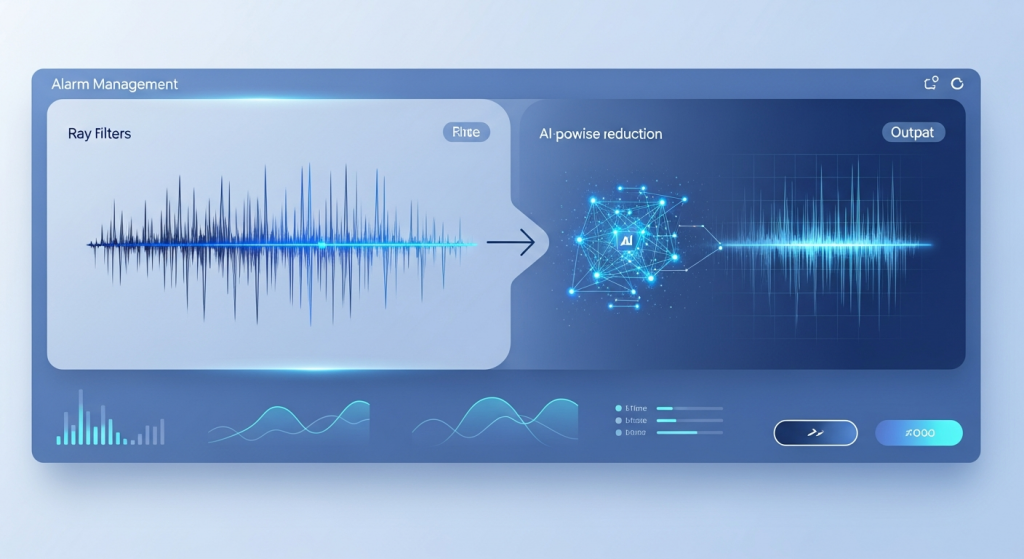
Alarm Management: How Many False Alarms Does Your Equipment Generate Every Day?
Three o’clock in the morning. The on-duty engineer’s phone buzzes again. Another equipment alarm. He glances at the message — like the dozen or so received in the past hour, it is most likely another false alarm. But he cannot afford to gamble. What if this one is real? He puts on his gown and heads to the cleanroom.
This scene plays out daily in semiconductor manufacturing. The alarm system is meant to be the guardian of equipment safety, but when it becomes a “boy who cried wolf” on repeat, engineer trust and efficiency are eroded bit by bit.
Alarm Flooding: An Underestimated Capacity Killer
Semiconductor equipment alarm systems are designed with a “better safe than sorry” philosophy — any condition that might affect process quality or safety should be captured. This principle is sound, but in practice, it leads to a pervasive problem: Alarm Flooding.
Consider these typical figures:
- A single semiconductor tool generates an average of 200-500 alarms per day
- 70%-90% of these are false alarms or low-priority alarms requiring no action
- An engineer must process thousands of alarms daily from multiple tools
- Truly critical alarms that require immediate intervention are buried in the information deluge
The consequences of alarm flooding extend far beyond mere annoyance:
Alarm fatigue. When 80% of alarms are false, engineers unconsciously lower their sensitivity to alarms. Psychological research shows that continuous exposure to high-frequency, low-value alarm environments reduces response accuracy by more than 60%.
Critical alarms get ignored. In the petrochemical industry, alarm fatigue has been confirmed as a contributing factor in multiple major accidents. While safety incidents are relatively rare in semiconductor manufacturing, critical alarms that go ignored can still result in costly batch scrap and equipment damage.
Wasted human resources. Engineering time is the production line’s scarcest resource. If a senior engineer spends 2 hours per day handling false alarms, that amounts to 500 hours of high-value labor wasted per year.
Why Do Traditional Alarm Systems Generate So Many False Alarms?
Understanding the sources of false alarms requires examining how traditional alarm systems work:
Single-parameter static thresholds. Traditional alarms operate on simple “if parameter X exceeds threshold Y, then alarm” logic. But semiconductor processes are multi-parameter coupled systems — a brief deviation in one parameter may be a normal dynamic adjustment (such as a PID controller’s regulation process) or a normal response to an upstream process step change. Single-parameter thresholds cannot distinguish between these situations.
Overly conservative threshold settings. To avoid “missing anything,” engineers tend to tighten threshold ranges when setting alarm limits. As equipment ages, the normal fluctuation range of certain parameters may drift, but thresholds are not updated accordingly, resulting in a growing number of false alarms.
Lack of context awareness. The same parameter value has entirely different meaning during equipment startup, steady-state operation, and shutdown phases. Traditional alarm systems do not differentiate equipment states and blindly apply the same set of rules.
No correlation between alarms. A single root cause failure may simultaneously trigger 5-10 related alarms. Traditional systems push each alarm individually, leaving engineers to determine cause and effect on their own.
AI-Powered Intelligent Alarms: From “Alarm Bombardment” to “Precision Notification”
AI redefines alarm management not by simply filtering out alarms, but by making every alarm meaningful.
1. Multi-Parameter Correlation Analysis
AI models simultaneously monitor dozens or even hundreds of equipment parameters, learning their normal inter-relationships. When a parameter deviates, AI makes a comprehensive judgment:
- Are other correlated parameters changing simultaneously? — If so, this may be a normal operating condition transition
- Does the direction and rate of deviation match a known pattern? — If it matches a degradation pattern, it warrants attention even if thresholds are not breached
- What operational phase is the equipment in? — Parameter fluctuations during startup and deviations during steady-state operation require entirely different handling strategies
Measured data shows that multi-parameter correlation analysis can reduce false alarm rates by 60%-80%, while actual anomaly detection rates actually improve by 15%.
2. Alarm Consolidation and Root Cause Focus
When a single root cause triggers a cascade of alarms, AI uses causal relationship analysis to consolidate multiple alarms into one root cause alarm. For example:
Traditional approach: Cooling water flow low -> Chamber temperature high -> Process deviation -> Film thickness anomaly -> Uniformity alarm — 5 separate alarms
AI approach: 1 root cause alarm — “Cooling water flow anomaly (possible causes: water valve, pump, piping). Has caused chamber temperature elevation and process deviation. Recommend prioritizing cooling system inspection.”
This not only reduces alarm volume but, more importantly, directs the engineer to the right course of action.
3. Intelligent Priority Ranking
Not all real alarms are equally urgent. AI dynamically calculates alarm priority based on the following factors:
- Scope of impact: How many WIP wafers could this anomaly potentially affect?
- Rate of progression: Is the anomaly accelerating or stabilizing?
- Historical consequences: Has a similar anomaly previously caused tool downtime or batch scrap?
- Current workload: Is the equipment processing high-value product or test wafers?
Priorities are classified into three levels — Immediate Action (red), Planned Response (orange), and Monitor (yellow) — ensuring that engineering attention stays focused on what matters most.
From Alarm to Action: Closed-Loop Management
Intelligent alarming should not stop at “sending notifications.” A complete alarm management closed loop comprises four stages:
- Detect: AI identifies real anomalies and filters out false alarms
- Diagnose: AI correlates historical data and provides a list of possible root causes with confidence scores
- Recommend: Based on the knowledge base and historical resolution records, recommended corrective actions are provided
- Verify: After corrective action, AI continues monitoring to confirm the anomaly has been eliminated and incorporates the case into the knowledge base
This closed loop not only improves the efficiency of handling individual alarms but also makes the system progressively “smarter” through knowledge accumulation.
Implementation Results: Real Data Speaks
A semiconductor equipment manufacturer deployed an AI alarm management system on 8 delivered tools. Data comparison after 3 months of operation:
| Metric | Before Deployment | After Deployment | Change |
|---|---|---|---|
| Daily alarm count (per tool) | 380 | 45 | Down 88% |
| False alarm rate | 82% | 12% | Down 70 percentage points |
| Average response time for critical alarms | 47 minutes | 8 minutes | Down 83% |
| Unplanned downtime due to alarm handling | 6.2 hrs/month avg. | 1.8 hrs/month avg. | Down 71% |
| Engineer overnight wake-ups | 4.5 times/week avg. | 0.7 times/week avg. | Down 84% |
The most frequently cited customer feedback was: “We can finally trust the alarms again.” When engineers regain trust in the alarm system, every alarm gets the attention it deserves, and equipment safety and stability improve in tandem.
Strategic Value for Equipment Manufacturers
For semiconductor equipment manufacturers, intelligent alarm management is an important differentiating capability for enhancing product competitiveness:
- Reduced after-sales burden: Fewer false alarms mean dramatically fewer customer support calls and on-site visits
- Improved customer satisfaction: Engineers who are no longer bombarded by alarms naturally rate the equipment more favorably
- Equipment knowledge accumulation: The anomaly patterns and resolution experience captured by the AI alarm system become core knowledge assets for the equipment manufacturer
- Next-generation product enablement: Insights from alarm data analysis can feed back into equipment design, reducing anomalies at the source
Say Goodbye to Alarm Bombardment — Let AI Guard Your Production Line
MST Semiconductor’s NeuroBox E3200 production line intelligence system features a built-in AI alarm management engine supporting multi-parameter correlation analysis, alarm consolidation, and intelligent priority ranking. Make every alarm meaningful, and make every engineering response count.