
Etch Process R2R Control: How AI Keeps CD On Target
Key Takeaway
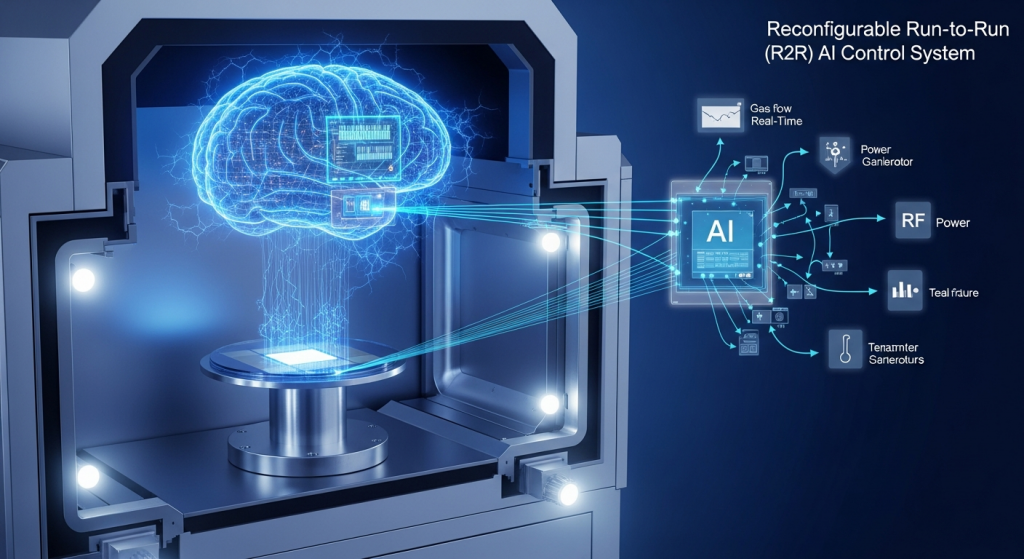
Etch R2R control reduces gate CD variation by 30–50% by automatically adjusting etch time, RF power, or gas flow based on incoming resist CD and etch rate feedback. AI models predict etch rate from chamber sensor data (VM), enabling per-wafer CD correction without slowing throughput. MST NeuroBox E3200S implements etch R2R with sub-10-second update latency.
Introduction: The CD Control Challenge in Plasma Etching
Critical dimension control in plasma etch is among the most demanding process control problems in semiconductor manufacturing. Unlike film deposition, where the output is a single bulk property—thickness—plasma etching defines the lateral dimensions that determine transistor drive current, leakage, and ultimately circuit speed and power. A gate CD that is 2 nm wider than target does not merely shift a threshold value; it changes the fundamental electrical character of the device.
The physical complexity of plasma etch makes it uniquely difficult to control. The etch process is not simply a chemical reaction proceeding at a rate determined by temperature and reactant concentration. It involves simultaneous ion bombardment from the plasma sheath, radical-driven chemical etching of the exposed film, passivation layer formation on pattern sidewalls, and reactive byproduct redeposition—all interacting in ways that depend sensitively on pattern geometry, incoming film stack properties, chamber wall condition, and plasma source characteristics that change continuously with tool age.
Against this backdrop, run-to-run (R2R) control with AI-powered virtual metrology represents the most practical and scalable path to maintaining gate CD at target across the full production lifetime of a technology node. This article covers the complete engineering picture, from the physical mechanisms that make etch CD drift, to the sensor signals that capture them, to the controller architecture and real fab results achieved with MST NeuroBox E3200S.
Why Etch CD Control Is Hard: The Four Core Challenges
Loading Effect and Microloading
The loading effect in plasma etch refers to the dependence of etch rate on the total exposed area of the material being etched. When more material is exposed—because more wafers are present in a batch system, or because a given wafer has a higher pattern density—more reactive species are consumed, depleting their concentration in the gas phase and reducing the etch rate available per unit area. In single-wafer tools, the primary loading effect is between lots with different pattern densities: a lot of memory arrays with 85 percent open area etches at a meaningfully different rate than a lot of logic die with 30 percent open area.
Microloading is the local version of the same phenomenon: etch rate varies across a single die based on the local pattern density surrounding each feature. Dense arrays etch more slowly than isolated lines even on the same wafer, because the local depletion of reactive species is more severe in high-density regions. Microloading is not directly correctable by R2R control—it requires process design and mask compensation strategies—but it contributes to the within-wafer CD non-uniformity that determines the floor below which R2R improvement cannot reach.
Chamber Aging and Polymer Accumulation
Plasma etch chambers accumulate polymer deposits on chamber walls, focus rings, and electrode surfaces as a byproduct of the etch chemistry. These deposits change the effective plasma chemistry by acting as a sink for reactive fluorine or chlorine species and as a source of carbon-containing fragments that modify plasma composition. The etch rate and CD bias drift systematically across the chamber seasoning cycle—the period between wet cleans—in a pattern that is repeatable but not constant across maintenance cycles as chamber components age.
The focus ring is particularly important. As the focus ring erodes from ion bombardment over its service life, the plasma sheath geometry near the wafer edge changes, causing progressive degradation of etch rate uniformity and a systematic shift in edge CD relative to center CD. Focus ring consumption tracking and R2R compensation based on ring age is a critical capability in advanced etch control.
Incoming Resist CD Variation from Lithography
Plasma etch does not operate on a perfectly defined pattern. The resist CD delivered from the lithography module carries its own run-to-run variation: scanner dose and focus drift, resist batch viscosity changes, and BARC thickness variation all contribute to shot-to-shot spread in the pre-etch CD. For a gate layer where the final silicon CD specification may be ±3 nm (3-sigma), a lithography contribution of ±2 nm leaves almost no margin for the etch step to add its own variation.
Etch bias—the difference between the post-etch silicon CD and the pre-etch resist CD—is not a fixed constant of the process. It depends on the resist CD itself through a nonlinear relationship driven by the aspect ratio of the resist pattern and the sidewall passivation chemistry. When resist CD is at the wide end of its distribution, etch bias tends to be larger; when resist CD is narrow, bias tends to be smaller. This CD-dependent bias means that a simple constant-offset model is insufficient for accurate etch CD prediction and correction.
ARDE: Aspect Ratio Dependent Etching
As features shrink and aspect ratios increase, the etch rate at the bottom of high-aspect-ratio features decreases relative to the rate in wider, shallower features. This aspect ratio dependent etching (ARDE) effect, also called RIE lag, occurs because ion flux and neutral species transport to the feature bottom are impeded by geometric shadowing and charge-up effects at high aspect ratios. ARDE causes incomplete etch in dense, narrow features even when the etch time is sufficient to clear isolated features, and it worsens as the pattern evolves during the etch—meaning the ARDE-driven CD error accumulates nonlinearly with etch time.
R2R control can partially compensate for ARDE by adjusting process pressure (which affects the ion angular distribution and improves deep-feature transport at lower pressure) and by adjusting the etch time to a value optimized for the specific pattern density of the incoming lot. However, complete ARDE compensation ultimately requires process engineering changes to the chemistry and hardware, not recipe parameter adjustment alone.
Key Etch Sensors for Process Control
Effective etch CD control requires dense, real-time sensor data from within the etch chamber. The following sensor categories provide the primary signals used in etch virtual metrology and R2R control:
- Optical emission spectroscopy (OES): OES monitors the light emitted by excited species in the plasma across a broad wavelength range. Specific emission lines correspond to specific species: the fluorine atomic line at 703.7 nm tracks etchant concentration, the silicon monofluoride (SiF) bands track etch byproduct generation rate, and the endpoint is detected from the characteristic drop in SiF emission when the silicon film clears. OES signal trajectories during a run encode information about etch rate, chamber wall condition, and polymer loading.
- RF impedance and delivered power: The RF generator reports forward and reflected power, and the match network position (capacitor positions) to the tool host. These signals reflect the plasma load impedance, which changes with plasma density, chemistry, and the dielectric properties of material deposited on chamber surfaces. Drift in match network capacitor positions across the seasoning cycle is one of the most reliable indicators of polymer accumulation state.
- Chamber pressure: The process pressure during etch is controlled by a throttle valve, but the pressure setpoint response time and the residual gas composition (measured by residual gas analysis or inferred from OES) carry information about chamber pumping efficiency and gas utilization.
- ESC temperature: Electrostatic chuck temperature determines the wafer temperature, which directly affects the chemical component of the etch rate through Arrhenius kinetics. ESC temperature stability and run-to-run reproducibility are key to achieving consistent etch bias.
- Focus ring and upper electrode temperature: Pyrometers or embedded thermocouples tracking these component temperatures provide early warning of conditioning state drift and can trigger compensatory adjustments before CD excursions occur.
Etch Rate Virtual Metrology from OES and RF Signals
Virtual metrology for etch rate uses machine learning models—most commonly gradient boosting or neural network architectures—trained on historical run data to predict end-of-run etch depth, etch rate, and CD bias from the in-situ sensor time series collected during each run.
Feature engineering is the most important step in building effective etch VM models. Raw OES spectra contain hundreds of wavelength channels sampled at 1 Hz or faster throughout the run, producing thousands of potential input features per run. Effective feature sets for etch VM typically include:
- Mean and standard deviation of key emission line intensities during the main etch step
- Ratio of etch product emission lines to etchant emission lines (a proxy for instantaneous etch rate)
- Time-integrated OES signal from wafer load to endpoint (proportional to total material removed)
- RF match capacitor position at stabilization (a proxy for chamber conditioning state)
- Delivered RF power stability (variance during the run, indicating plasma ignition quality)
- Cumulative wafer count since last chamber clean (a proxy for polymer loading)
- Incoming resist CD from the previous lithography step (if available from MES)
Models trained on 500 to 1,000 historical runs with this feature set typically achieve etch rate VM prediction errors of 1 to 3 percent of the process window, and CD bias prediction errors of 0.5 to 1.5 nm—sufficient to drive meaningful R2R correction in a 3 nm CD budget.
Litho-Etch Cascade Control Architecture
The single most effective enhancement to standalone etch R2R feedback control is the addition of a lithography feedforward path. In a cascade control architecture, the pre-etch resist CD measurement—taken from the CD-SEM or OCD metrology step after development—is fed to the etch R2R controller as an incoming disturbance signal, allowing the etch recipe to be proactively adjusted for the specific resist CD of the lot about to enter the etch chamber.
The cascade controller structure combines two correction terms:
- Feedforward from incoming resist CD: The etch bias model predicts the expected post-etch CD as a function of the measured incoming resist CD. If the resist is wide by 1.5 nm relative to target, the etch controller extends the overetch slightly to drive the silicon CD back toward target through the CD-dependent bias relationship.
- Feedback from post-etch CD measurement: The EWMA feedback controller corrects for the residual systematic error in the etch bias model—chamber conditioning drift, RF aging effects, and other disturbances not captured by the feedforward path.
Production results from cascade R2R on 28 nm gate CD control show that adding litho feedforward to etch feedback reduces final post-etch CD sigma by an additional 20 to 30 percent compared to etch feedback control alone. This improvement comes directly from removing the lithography variation component from the etch R2R controller’s error signal, allowing the feedback controller to focus exclusively on etch-step disturbances.
R2R Controller for Etch: Manipulated Variables
The etch R2R controller has three primary manipulated variables available for CD correction. The choice of which variable to adjust—or which combination to use in a multi-variable controller—depends on the dominant disturbance type and the sensitivity of other process outputs to each variable.
Etch Time
Etch time is the most commonly used manipulated variable in etch R2R because it directly controls the total amount of material removed (at a given etch rate) and because it is easily adjustable in the recipe without affecting plasma conditions. The sensitivity of post-etch CD to etch time depends on the sidewall passivation chemistry: in highly passivating chemistries (e.g., HBr/Cl2/O2 for polysilicon gate etch), longer etch time causes relatively small CD change because the sidewall passivation layer protects the feature from lateral etch; in less passivating chemistries, the CD-to-time sensitivity is higher. Process gain for the etch time controller is typically characterized in nm per second of additional overetch.
RF Power (Bias)
The bias RF power—the low-frequency RF applied to the electrode on which the wafer sits—controls the ion energy delivered to the wafer surface. Higher bias power increases the physical sputtering component of the etch, which removes passivation layers and drives anisotropic etching. Adjusting bias power as an R2R manipulated variable changes both the etch rate and the etch anisotropy, making it a more powerful but also more complex actuator than etch time. Bias power adjustments are appropriate for correcting chamber aging effects that shift the balance between chemical and physical etch components.
Gas Flow and Pressure
Gas composition and process pressure are the most impactful manipulated variables for etch selectivity and microloading compensation, but they are also the least commonly used in R2R control because they affect the etch chemistry globally rather than through a simple gain relationship with CD. For specific applications—notably adjusting the oxygen flow in polysilicon gate etch to compensate for polymer loading state, or adjusting process pressure to correct for ARDE-driven CD variation across pattern density splits—gas flow R2R adjustments deliver results that time and power corrections cannot achieve.
ARDE Effect Compensation Through R2R
Aspect ratio dependent etching creates a systematic CD error that correlates with the pattern density and aspect ratio of the incoming lot. While full ARDE correction requires process engineering, R2R control can significantly reduce the lot-to-lot CD variation caused by the mix of different die designs processed on the same tool.
ARDE compensation in R2R is implemented by classifying incoming lots by pattern type—using the lot product ID or reticle ID from the MES—and maintaining separate controller state variables for each pattern class. When a lot of a given pattern type enters the tool, the controller initializes from the state history for that pattern class rather than from the global tool state, effectively operating as a pattern-specific R2R loop within the shared tool context.
This multi-recipe R2R architecture requires a controller platform that can manage multiple simultaneous control loops on a single tool—a capability directly supported by NeuroBox E3200S, which maintains independent EWMA state histories for up to 64 recipe contexts per tool.
Multi-Chamber CD Matching
High-volume fabs run the same process step on multiple identical etch chambers in parallel to achieve the required throughput. Without active chamber matching, inter-chamber CD variation of 2 to 5 nm is typical due to differences in hardware history, consumable age, and chamber-specific conditioning patterns. This variation is a major source of within-lot CD spread when lots are dispatched across multiple chambers.
Multi-chamber R2R control treats one chamber as the reference and runs R2R controllers on the remaining chambers to minimize the CD difference between each chamber and the reference. The manipulated variables for chamber matching are typically the etch time offset and the bias power offset—small adjustments from the common baseline recipe that bring each chamber’s CD output into alignment with the reference.
Implementing multi-chamber matching requires three capabilities: per-chamber CD metrology with sufficient sample rate to track individual chamber drift, a controller that can apply different recipe offsets to each chamber while maintaining a common baseline, and MES integration that ensures wafers are dispatched to the correct recipe version when the lot enters the tool. NeuroBox E3200S provides all three through its multi-chamber controller module, which manages chamber-specific offsets within a common recipe framework and interfaces with the MES dispatch system to ensure the correct chamber-specific recipe is applied to each wafer.
Production deployments of multi-chamber matching on 4-chamber etch clusters have achieved inter-chamber CD matching of better than 1 nm (3-sigma), reducing lot-to-lot CD variation from chamber mix dispatching by 60 to 70 percent.
NeuroBox E3200S: Etch R2R in Production
MST NeuroBox E3200S provides a complete etch R2R implementation that spans VM model training, controller deployment, litho feedforward integration, and multi-chamber matching in a single platform. Key features specific to etch process control include:
- Sub-10-second VM-to-recipe update latency: The E3200S VM engine processes OES and RF data streams in near real time, generating a CD prediction within 8 seconds of run end. The R2R controller ingests this prediction, computes the recipe update, and delivers the updated recipe to the tool SECS/GEM interface before the next wafer begins transfer from the load lock. This latency target is met even at 300 mm wafer transfer times as short as 90 seconds.
- OES feature extraction pipeline: E3200S includes a built-in OES preprocessing pipeline that performs wavelength selection, baseline correction, and time-window feature extraction from raw spectrometer data, eliminating the need for custom scripting to prepare OES data for VM model training.
- Focus ring age tracking: E3200S maintains a focus ring usage accumulator (in RF-hours or wafer count) and includes focus ring age as an automatic feature in the etch VM model, enabling the model to learn the systematic CD trend associated with ring erosion and compensate accordingly.
- Pattern density feedforward: By querying the MES for the reticle ID of each incoming lot, E3200S can apply pattern density-specific feedforward offsets to the etch time or power setpoint, compensating for the loading effect difference between dense memory and sparse logic products on the same tool.
- Multi-chamber orchestration: The E3200S multi-chamber module manages up to 8 chambers per process step, maintaining independent EWMA states for each chamber while coordinating on a common reference target. Chamber-specific recipe offsets are delivered to the MES as recipe parameter overrides, preserving the baseline recipe integrity in the MES version control system.
Real Fab Results: Etch CD Control with NeuroBox E3200S
The following results were achieved in production deployments of E3200S etch R2R at customer fabs processing 300 mm wafers at technology nodes from 28 nm to 5 nm equivalent:
| Application | Manipulated Variable | CD Sigma Before | CD Sigma After | Reduction |
|---|---|---|---|---|
| Polysilicon gate etch (28 nm) | Etch time + litho feedforward | 2.8 nm | 1.4 nm | 50% |
| Fin etch (7 nm equivalent) | Bias power + etch time | 1.9 nm | 1.1 nm | 42% |
| Contact hole etch (14 nm) | Etch time + O2 flow | 3.5 nm | 2.1 nm | 40% |
| Multi-chamber CD matching (4 chambers) | Per-chamber etch time offset | 4.1 nm inter-chamber | 0.9 nm inter-chamber | 78% |
In addition to CD improvement, customers have reported a 45 percent reduction in lot dispositions triggered by etch CD excursions, directly translating to reduced rework and scrap costs. The elimination of engineer-driven manual recipe corrections—which previously averaged 8 to 12 adjustments per etch tool per week in high-mix fabs—freed process engineering bandwidth for root cause analysis and process development rather than production firefighting.
Deployment Approach: From Data to Closed Loop
Deploying etch R2R with E3200S follows a four-phase methodology that minimizes production risk while achieving fast time-to-value:
- Data collection and characterization (Weeks 1–2): E3200S connects to the target etch tool and MES in passive data collection mode. All OES, RF, and recipe data are logged alongside any available post-etch metrology. No production changes are made. At the end of this phase, a VM model is trained on the collected data and its prediction accuracy is validated against held-out run data.
- Open-loop simulation (Week 3): The R2R controller runs in shadow mode: it computes and logs the recipe corrections it would apply to each lot but does not deliver them to the tool. The shadow corrections are reviewed by the process engineer to validate controller behavior and confirm that the computed corrections are physically reasonable.
- Closed-loop with engineer approval (Week 4): The controller transitions to closed-loop operation with engineer approval required for each correction. This phase builds confidence in the controller behavior and catches any edge cases in the MES recipe delivery path before fully autonomous operation begins.
- Autonomous operation: Upon successful completion of the approval phase, the controller operates fully autonomously within the configured correction limits. Engineering review is required only when cumulative correction limits are approached or when the VM model prediction error exceeds a configured quality threshold.
Conclusion
Etch CD control is one of the highest-leverage applications of run-to-run control in semiconductor manufacturing. The combination of physical drift mechanisms—chamber aging, focus ring erosion, loading effect variation—with strong sensitivity of final CD to incoming resist variation from lithography creates a multi-source disturbance environment that manual recipe management cannot reliably address at the wafer volumes required for profitable production.
AI-powered virtual metrology that extracts etch rate and CD bias predictions from OES and RF sensor data, combined with cascade litho-etch feedforward control and multi-chamber CD matching, provides a complete solution that reduces gate CD variation by 30 to 50 percent and enables sub-10-second closed-loop response from run completion to updated recipe delivery. MST NeuroBox E3200S delivers this capability on any SECS/GEM-compliant etch tool with a four-week deployment methodology that protects production throughout the transition to autonomous control.
Contact MST to schedule a technical assessment of your etch CD control challenges and receive a deployment plan tailored to your specific process step, tool configuration, and metrology infrastructure.
这篇属于 NeuroBox D 设计自动化场景
获取一份 NeuroBox D 设计自动化评估,看看 P&ID 到 SolidWorks 原生装配体如何接入您的工程流程。
把 P&ID 图纸类型、客户零件库现状、3D 空间边界和装配规则发给我们。工程团队会先判断适合从哪一个机械设计环节切入,再给出落地建议。
- 适合设备商、气路/机械设计、CAD 自动化和工程复核团队
- 可从 P&ID、SolidWorks 零件库、装配规则和空间边界开始
- 优先评估旁接式本地 D 盒子,不要求上传机密图纸到公有云
Deploy real-time AI process control with sub-50ms latency.